… Because I’m behind the great firewall.
It actually quite surreal being unable to check twitter – I didn’t realize I would miss it so much.
However, I can apparently still blog so will have a post on Tuesday.
… Because I’m behind the great firewall.
It actually quite surreal being unable to check twitter – I didn’t realize I would miss it so much.
However, I can apparently still blog so will have a post on Tuesday.
Evolving thought:
One of the large challenges of the 21st century is going to be reconciling our increasingly networked world with traditional notions of individualism.
The more I look at a networked world – not in some geopolitical sense but on a day to day experience for everyone – the more it appears that many of the core to elements of liberal individualism are going to be challenged. Authorship is a great example of this dynamic playing out – yes Wikipedia makes it impossible to identify who an author is – but even tweets, and blogs and all forms of digital medium confuse who is the original author of a work. More over, we may no longer live in a world of unique individual thought. As Kevin Kelly so remarkably documents in What Technology Wants by looking at patent submissions and scientific papers, it is increasingly apparent that technologies are being simultaneously discovered everywhere, the notion of attributing something to an individual may be at best difficult, at worst impossibly random.
And of course networked systems disproportionately reward hubs. Hubs in a network attract more traffic (ideas/money/anything) and therefor may appear to many others in the network as the source of these ideas as they are shared out. I for example get to hear more about open data, or technology and government, then many other people, as a result my thinking gets to be pushed further and faster allowing me to in turn share more ideas that are of interest and attract still more connections. I benefit not simply from inherent individual abilities, but from the structure of, and my location in, a network.
Of course, socialist collectivism is going to be challenged as well in some different way but I think that may be less traumatic for our political systems the a direct challenge to individualism – something many centrist and right leaning parties may struggle with.
This is all still half formed but mental note for myself. More thinking/research on this needed. Open to ideas, articles, etc…
A few months ago the Canadian Real Estate Association’s (CREA) board invited me to speak to their board about open/platform strategies and the future of the real estate industry. Last week I was invited back to give a similar talk at their annual general meeting in Ottawa.
I had a great time at both conferences and was impressed with how both the leadership and membership were trying to come to grips with the rapidly changing environment of their industry. I’m also impressed and grateful that they invited me – someone whose perspective they knew would challenge them – and that they engaged my ideas so openly.
A number of CREA members have asked if I would share my slide deck, so I’ve done so below.
Also posted below is the graphic facilitation created by the very talented Avril Orloff who drew these while I was giving my talk!
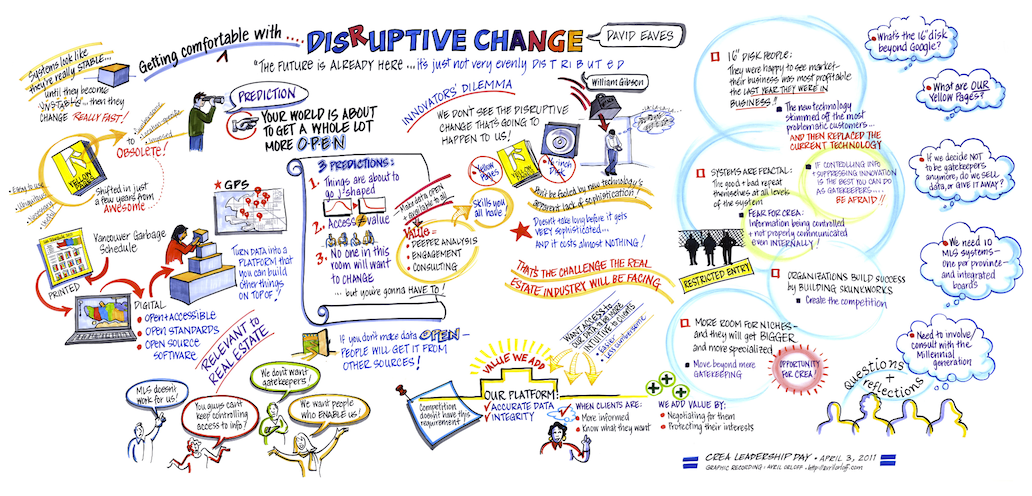
And here are the slides!
I’ve been following with great interest the efforts of Intellog Blog’s effort’s to get the Government of Alberta to gain access to the location of all oil and gas wells in the Western Sedimentary Basin. Their goal is pretty simple, they want to spur research and increase awareness around the economic opportunities, health consequences and environmental implications of the drilling by making the data available. Such a conversation is, of course, made a whole lot easier if one has actual accurate information to reference.
Of course the government (paid via Alberta tax dollars) collects this information. It has simply decided that it can use the information, but no one else can.
Indeed, the Intellog Blog has struggled for 3 years to get this information. This despite the fact that the Alberta Freedom of Information and Protection of Privacy Act (FOIPPA) is abundantly clear about this: FOIPPA requires public bodies to make information available to the public that is clearly in the public interest including the environment or public health or safety.
Today the issue is before the Alberta Access to Information Commissioner, who I hope makes the right decision. Alberta (and many governments) has a dubious history of not sharing information, or even misleading the public about critical issues around health impacts.
It’d be nice to see the commissioner send a message and start to shift the culture.
I find it fascinating how US government has chosen to try to dismantle the support network that makes wikileaks possible – pressuring paypal, amazon and numerous others into refusing to enable wikileaks to work.
They have pressured pretty much every stakeholder with one exception. The traditional media.
Why does the US government rail against wikileaks and pressure paypal and yet is silent about the New York Times involvement? (or the Guardian’s or the other media partners involved?). The NYT had advance access to the materials, they helped publicize it and, in the case of the Guardian, have been helping users get access to the wikileak documents when wikileaks website went down.
This fact, above all else, demonstrates the weakness the government’s legal case. They aren’t going after those who have a clear mission and the (legal) capacity to protect themselves. They are trying to go after those who can be pressured. This is not a sign of confidence. This is a shakedown. More importantly, it is a sign of weakness.
The fact that organizations like Amazon and Paypal have caved so quickly should also be a red flag for anyone who care about free speech. Essentially, these companies have conceded that – regardless of whether you break the law or not – if the government tells them to not serve you so that you can operate on the net, they will kick you off their platforms. As one great tweet put it: “If Amazon is uncomfortable with free speech they should get out of the book business.”
I see three outcomes from all this.
Winner: Traditional media. They establish one area where they have a competitive advantage: the capacity to marshal legal forces to not only protect their free speech rights, but to pre-emptively prevent the government from even contemplating attacking them. That’s powerful stuff, especially in a world where governments not appear happy to not attack those they disagree with directly but simply attempt to shut down the infrastructure that enables them.
Loser: Paypal, Amazon and others who caved. Maybe the long term effect of this will be negligible but it is also possible that a number of people who are choosing their cloud computing provider right now will be looking at Google which (eventually) stood up to China and Amazon, which caved like a house of cards at the mere breadth of dissatisfaction from the US government. Do you really want a company that is that susceptible to outside pressure running a core component of your business?
Biggest Loser: The US government. The worse part of the US government’s strategy of shutting down Wikileaks is it is has made the story (and the organization) more popular and better known. But more importantly it is counterproductive. Watching the US government deal with wikileaks is like watching the record labels try to fight Napster in the 1990s. Even if you win the battle, you will lose the war. Even if wikileaks gets shut down, 10 more lookalikes will pop up in its place, some of which will be more mainstream (and so harder to discredit) and others which will be more radical (and so more damaging). So all the US government has managed to do is make itself look like China when it comes to the rule of law, the governance of the internet, and the issue of censorship. You don’t have to be a rocket scientists to see the hypocrisy of the US government encouraging Twitter to not do maintenance during the Green Revolution in Iran so that people can communicate, while busily trying to shut down Wikileaks when the internet and network communication doesn’t serve its own interests. The US has damaged its brand and credibility with little to show for gains.
In the end, the system will react (it already has) and this will prompt new infrastructure on the net that better protects freedom of speech and places the capacity to control content even further beyond the reach of governments. There are downsides to all this, including the havoc of organizations like wikileaks can wreak on businesses and governments, but from a free speech perspective, it will be a good thing.
The is a repost of yesterday’s piece – but in french with thanks to the parliamentary committee on Access to Information, Privacy and Ethics which translated it.
L’autre semaine, j’ai reçu une invitation du Comité canadien permanent du Parlement sur l’accès à l’information, de confidentialité et d’éthique de venir témoigner au sujet de données open gouvernement et ouvert le 1er Février.
Le Comité a beaucoup parlé de ses efforts pour se livrer à une étude d’un gouvernement ouvert et depuis Février 1er est un peu loin et je voudrais être utile avant mon témoignage, je pensais que je projet de quelques réflexions et suggestions pour la comité de la stratégie. Je sais que ce sont non sollicités, mais j’espère qu’ils sont utiles et, si non, qu’ils ont au moins susciter des réflexions utiles.
1. Établir une compréhension commune de l’état actuel des choses
Tout d’abord, le plus grand risque pour le moment, c’est que les travaux du Comité pourrait en fait ralentir les efforts du gouvernement pour lancer une stratégie de données ouvertes. Les travaux du Comité, et la rédaction de son rapport, est tenu de prendre plusieurs mois, ce serait une honte si le gouvernement décidait de retenir le lancement d’initiatives en prévision de ce rapport.
Par conséquent, mon espoir est que le comité, au plus tôt est possible, demander à parler à l’agent principal de l’information du gouvernement du Canada pour obtenir une mise à jour concernant l’état actuel d’un gouvernement ouvert et ouvert initiatives des données, si elles existent. Cela a) créer une compréhension commune concernant l’état actuel des choses pour les membres du comité et des témoins; b) permettre le témoignage et recommandations ultérieures à prendre en considération le travail déjà fait et c) permettre au comité de
structurer son travail afin de ne pas ralentir les efforts en cours qui pourraient être déjà en cours.
2. Transformer le Comité dans un groupe de travail du gouvernement 2.0 – semblable à l’effort de l’Australie
Franchement, mon approche préférée dans cet espace a été la Colombie.
Deux gouvernement, un travail, un conservateur ont agressive menée une stratégie de données ouvertes et la transparence du gouvernement. Cela
serait mon espoir pour le Canada. Toutefois, il ne semble pas que c’est actuellement le cas. Donc, un autre modèle devrait être adopté.
Heureusement, un tel modèle existe.
L’an dernier, sous la direction de Nicholas Gruen, le gouvernement australien a lancé un groupe de travail sur le gouvernement 2.0 qui j’ai eu le plaisir de siéger au Groupe de référence international. L’Australien Taskforce a été non-partisane et était composé d’experts en politique et technique et des entrepreneurs de gouvernement, les
entreprises, les universités et institutions culturelles. Plus important encore, l’écrasante majorité de ses recommandations ont été adoptées.
Pour répliquer son succès au Canada, je crois que le Comité devrait copier les meilleurs éléments du groupe de travail australien. La question de l’accès des Canadiens à leur gouvernement est d’une importance capitale pour tous les Canadiens – à but non lucratif, aux intérêts des entreprises, aux fonctionnaires et, bien sûr, aux citoyens
de tous les jours. Plutôt que de non-partisan, je dirais que un groupe de travail canadien devrait être pan-partisane – que la commission est déjà. Toutefois, comme l’Australian Taskforce il devrait inclure un certain nombre de politiques et des experts techniques de l’extérieur du gouvernement. Ce comité serait de remplir ce que cela représente à la fois une politique transversale et une connaissance approfondie dans le domaine émergent de gouvernement 2.0. On pourrait donc, dans son ensemble, efficacement et rapidement des projets de recommandations au Parlement.
Le meilleur de tous, en raison de l’étape 1, ce travail pourrait se dérouler en parallèle à des projets (le cas échéant) déjà engagé par le gouvernement et peut-être même d’informer ces travaux en fournissant des mises à jour intermédiaires.
Je reconnais qu’une telle approche peut-être trop radical, mais j’espère qu’il est au moins un point de départ pour une approche intéressante.
3. Prêcher par l’exemple
Il ya une scène où les politiciens ne doivent pas attendre le gouvernement de faire des plans: le Parlement lui-même. Au cours de l’année écoulée, tandis que dans les conversations avec le directeur parlementaire du personnel des TI ainsi que le Président de la Chambre, j’ai travaillé pour que le Parlement font plus de données sur ses propres opérations ouvertes. A partir de Janvier, le site Web parlementaire commencent à libérer dans le Hansard XML – cela rendra beaucoup plus facile pour les développeurs de logiciels comme les créateurs de Openparliament.ca au fur et à howdtheyvote.ca pour gérer leurs sites et pour les étudiants, chercheurs et journalistes à la recherche et d’analyser les plus importantes de notre pays des débats publics. En bref, en faisant le compte rendu plus accessible le Président et son personnel des TI sont rendre le Parlement plus accessible. Mais ce n’est que le début de ce que les parlementaires pourraient faire pour un Parlement vraiment ouvert. Les horaires de la Chambre et du Sénat et l’ordre du jour, avec des calendriers comité devrait tous être ouverts. Donc, pour les deux devraient disposition des sièges des chambres. photos membres et bios devrait être partagée avec une licence illimitée de même que les vidéos du parlement.
Leadership dans cet espace enverrait un puissant message à la fois le gouvernement et la fonction publique que les politiciens du Canada sont sérieux au sujet de rendre le gouvernement plus ouvert et accessible à ceux qui l’ont élu. En outre, il pourrait également influencer législature provinciale et même les gouvernements municipaux, les incitant à faire de même et ainsi de renforcer notre démocratie à tous les niveaux.
4. Enfin, de comprendre votre tâche: Vous êtes la création d’un gouvernement de connaissances pour une société de la connaissance
Une raison pour laquelle je conseille la Commission à prendre sur les membres de l’extérieur parce que, louable, beaucoup admettent ce sujet est nouveau pour eux. Mais je veux aussi les membres du comité à comprendre la gravité de leur tâche. Open Gouvernement, Open Data et / ou de gouvernement 2.0 sont les premières étapes importantes dans un projet beaucoup plus vaste.
Qu’est-ce que vous êtes vraiment aux prises avec voici ce que le gouvernement va ressembler dans une économie du savoir et une société de la connaissance. Comment va fonctionner avec les travailleurs du savoir que les employés? Et, plus important encore, comment ça va faire participer les citoyens des connaissances, beaucoup d’entre eux peuvent et veulent apporter une contribution réelle au-delà des impôts qu’ils paient et n’ont pas besoin du gouvernement de s’auto-organiser?
En bref, ce qui est une connaissance fondée gouvernement va ressembler?
Au centre de cette question est de savoir comment nous gérons et partager l’information. L’élément de base d’une société axée sur le savoir.
Regardez autour de vous, et vous pouvez voir comment le monde numérique transforme la manière dont nous faisons tout. Peu d’entre nous peuvent imaginer de vivre aujourd’hui sans accès à l’internet et l’abondance d’informations qu’il nous apporte. En effet, nous avons déjà tellement habitués à l’Internet, nous oublions combien elle a changé radicalement des pans entiers de notre vie et l’économie de l’industrie du Voyage et de la musique au poste de politiques de collecte de fonds et au journalisme.
Si aujourd’hui, notre gouvernement reste largement ressemble et se sent comme une institution façonnée par la presse, c’est parce que, ainsi qu’il est. Sous-ministres et les ministres reçoivent encore des cahiers d’information géant rempli de papier. Il s’agit d’un reflet de la façon dont nous traitons dans l’information et des connaissances au sein du gouvernement, nous le déplacer (pour de bonnes raisons) dans siloes, d’exploitation, comme si les réseaux, la recherche avance, et d’autres innovations n’existent pas (même si elles le font déjà).
Comment notre gouvernement traite l’information est au cœur de votre tâche. Je ne dis pas que vous avez à réinventer le gouvernement ou à démanteler tous les silos et les ministères. Bien au contraire, je crois que de petits changements peuvent être faits qui donneront des avantages significatifs, l’efficacité et des économies tout en améliorant notre démocratie. Mais vous serez face à des décennies, sinon des siècles de tradition, la culture et le processus dans une institution qui est sur le point de passer par le plus grand changement depuis l’invention de l’imprimerie. Vous n’avez pas à tout faire, mais même certains petits premier ne sera pas facile. Je partage ce point parce que je veux que tu vas à la tâche avec les yeux grands ouverts.
À tout le moins, nous n’allons pas d’abord, nos cousins à la fois à travers l’Atlantique, du Pacifique et de notre frontière sud ont déjà franchi le pas. Mais cela ne doit ajouter l’urgence de notre tâche. Nous ne pouvons pas se permettre de rester alors que d’autres par le renouvellement de leurs institutions démocratiques tout en renforçant un pilier émergents et critique d’une nouvelle économie du savoir et société de la connaissance.
Building on the post from earlier today…
For those running or participating in the International Open Data hackathon this weekend who are still looking for ideas to hack on the Sunlight Foundation have a number of applications that are open source and could be “localized” to meet local needs.
The always awesome Eric Mill shared some of this promising candidate:
The “Congress” app for Android has been very successful (>350K downloads) and, of course, is open source, so the code can be found here.
What’s required to “localize it”
a) Some translating (something non-developers could do)
b) identifying local data sources (something non-developers could do)
c) likely some restructuring to deal with that particular countries’ legislative structure.
Eric posted some information about it on the Sunlight Foundation’s blog here and the source code is open at Github. There is no documentation yet (although this could be another project for Saturday), but Eric is keen to work with any groups who want to work on it.
Two other projects include:
TransparencyData.com to which the source code can be found on Github here.
InfluenceExplorer.com not sure if the source code is available, but a good amount of interesting information can be found on the about page. My sense is that this project will be much more challenging…
Hope these inspire some good thoughts.
Okay, going to be blogging a lot more about the international open data hackathon over the next few days. Last count had us at 63 other cities in 25 countries on over 5 continents.
So first and foremost, here are three thoughts/ideas/actions I’m taking right now:
First, for those who have been wondering… yes, there will be an IRC channel on Dec 4th (and as of now) that I will try to be on most of the day.
irc.oftc.net #odhd
This could be a great place for people with ideas or open sourced projects to share them with others or for cities that would like to present some of the work they’ve done on the day with others to find an audience. If, by chance, work on a specific project becomes quite intense on the IRC channel, it may be polite for those working on it to start a project specific channel, but we’ll cross the bridge on the day.
Two additional thoughts:
Second, some interesting projects brainstorms have been cropping up on the wiki. Others have been blogging about them, like say these ideas from Karen Fung in Vancouver.
Some advice to people who have ideas (which is great).
a) describe who the user(s) would be and what the application will it do, why would someone use it, and what value would they derive from it.
b) even if you aren’t a coder (like me) lay out what data sets the application or project will need to draw upon
c) use powerpoint or keynote to create a visual of what you think the end product should look like!
d) keep it simple. Simple things get done and can always get more complicated. Complicated things don’t get done (and no matter how simple you think it is… it’s probably more complicated than you think
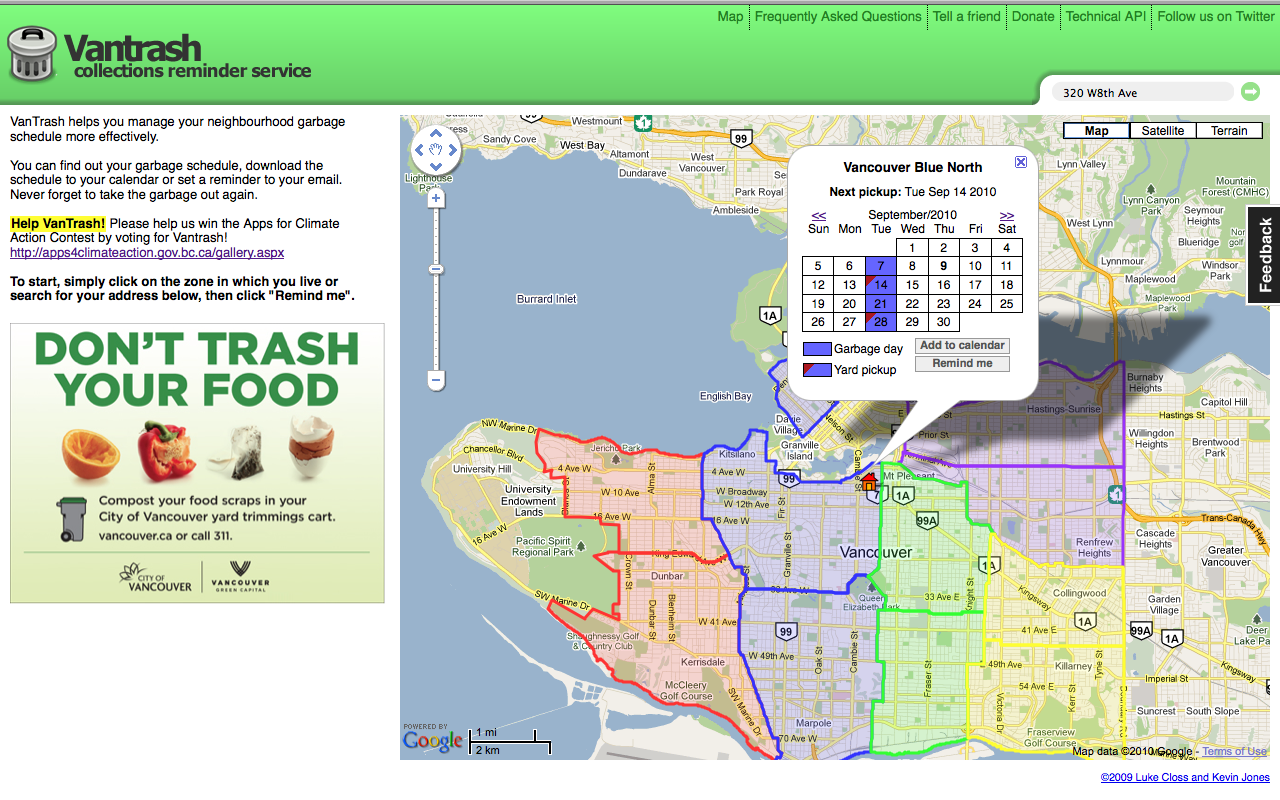
These were the basic principles I adhered when laying out the ideas behind what eventually became Vantrash and Emitter.ca.
Look at the original post where I described what I think a garbage reminder service could look like. Look how closely the draft visual resembles what became the final product… it was way easier for Kevin and Luke (who I’d never met at the time) to model vantrash after an image than just a description.
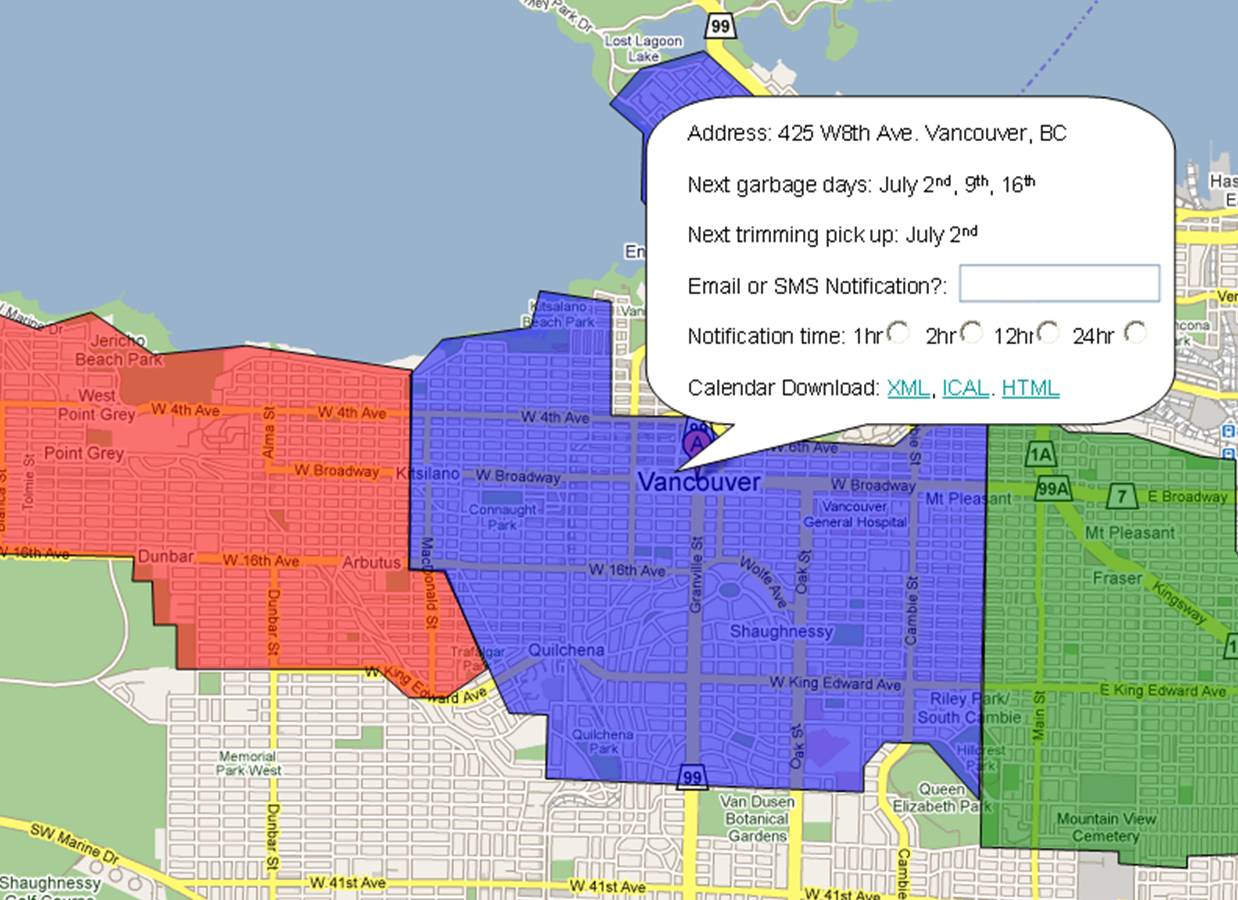
Mockup
A number of projects have been put forward as initatives that could be localized. I wanted to highlight a few here:
People could create new instances of the site for a number of different countries. If you are interested, please either ping wdmmg-discuss or wdmmg (at) okfn.org.
Things non-developers could do:
b) OpenParliament.ca
If you live in a country with a parliamentary system (or not, and you just want to adapt it) here is a great project to localize. The code’s at github.com/rhymeswithcycle.
Things non-developers can do:
c) How’d They Vote
This is just a wonderful example of a site that creates more data that others can use. The API’s coming out of this site save others a ton of work and essentially “create” open data…
d) Eatsure
This app tracks health inspection data of restaurants done by local health authorities. Very handy. Would love to see someone create a widget or API that companies like Yelp could use to insert this data into the restaurant review… that would be a truly powerful use of open data.
The code is here: https://github.com/rtraction/Eat-Sure
Do you have a project you’d like to share with other hackers on Opendataday? Let me know! I know this list is pretty North American specific so would love to share some ideas from elsewhere.
Just a quick apology to blog readers this week, I know I’ve only blogged once – announcing the launch of datadotgc.ca v2. Between that, the launch of emitter.ca (more on that tomorrow), OpenGovWest BC, the growing international open data hackathon and a few other things, I’ve been feeling a little like this:
Have a post on emitter tomorrow though…
In the past few years a number of governments have launched open data portals. These sites, like www.data.gov or data.vancouver.ca share data – in machine readable formats (e.g. that you can play with on your computer) that government agencies collect.
Increasingly, people approach me and ask: what makes for a good open data portal? Great question. And now that we have a number of sites out there we are starting to learn what makes a site more or less effective. A good starting point for any of this is 8 Open Government principles, and for those newer to this discussion, there are the 3 laws of open data (also available in German Japanese, Chinese, Spanish, Dutch and Russian).
But beyond that, I think there are some pretty tactical things, data portal owners should be thinking about. So here are some issues I’ve noticed and thought might be helpful.
Probably the single greatest mistake I’ve seen governments make is, in the rush to get some PR or meet an artificial deadline, they create a data portal in which the data must be updated manually. This means that a public servant must run around copying the data out of one system, converting (and possibly scrubbing it of personal and security information) and then posting it to the data portal.
There are a few interrelated problems with this approach. Yes, it allows you to get a site up quickly but… it isn’t sustainable. Most government IT departments don’t have a spare body that can do this work part time, even less so if the data site were to grow to include 100s or 1000s of data sets.
Consequently, this approach is likely to generate ill-will towards the government, especially from the very community of people who could and should be your largest supporters: local tech advocates and developers.
Consider New York, here is a site where – from I can tell – the data is not regularly updated and grumblings are getting louder. I’ve heard similar grumblings out of some developers and citizens in Canadians cities where open data portals get trumpeted despite infrequent updates and having few data sets available.
If you are going to launch an open data portal, make sure you’ve figured out how to automate the data updates first. It is harder to do, but essential. In the early days open data sites often live and die based on the engagement of a relatively small community or early adopters – the people who will initially make the data come alive and build broader awareness. Frustrate the community and the initiative will have a harder time gaining traction.
Both the 8 principles and 3 laws talk a lot about licensing. Obviously there are those who would like the licenses on many existing portals to be more open, but in most cases the licenses are pretty good.
What you shouldn’t do is require users to register. If the data is open, you don’t care who is using it and indeed, as a government, you don’t want the hassle of tracking them. Also, don’t call your data open if members must belong to a educational institution or a non-profit. That is by definition not data that is open (I’m looking at you StatsCan, its not liberated data if only a handful of people can look at it, sadly, you’re not the only site to do this). Worst is one website that, in order to access the online catalogue you have to fax in a form outlining who you are.
This is the antithesis of how an open data portal should work.
The real problem is when sites demand too much of users to even gain access to the data. Readers of this blog know about my feelings regarding Statistics Canada’s website, the data always seems to be one click away. Of course, that’s if you even think you are able to locate the data you are interested in, which usually seems impossible to find.
And yes, I know that Statistics Canada’s phone operators are very helpful and can help you locate datasets quickly – but I submit to you that this is a symptom of a problem. If every time I went to Amazon.com I had to call a help desk to find the book I was interested in I don’t think we’d be talking about how great Amazon’s help desk was. We’d be talking about how crappy their website is.
The point here is that an open data site is likely to grow. Indeed, looking at data.gov and data.gov.uk these sites now have thousands of data sets on them. In order to be navigable they need to have excellent design. More importantly, you need to have a new breed of librarian – one capable of thinking in the online space – to help create a system where data sets can be easily and quickly located.
This is rarely a problem early on (Vancouver has 140 data sets up, Washington DC, around 250, these can still be trolled through without a sophisticated system). But you may want to sit down with a designer and a librarian during these early stages to think about how the site might evolve so that you don’t create problems in the future.
Finally, I think good open data portals want, and even encourage feedback. I like that data.vancouver.ca has a survey on the site which asks people what data sets they would be interested in seeing made open.
But more importantly, this is an area where governments can benefit. No data set is perfect. Most have a typo here or there. Once people start using your data they are going to find mistakes.
The best approach is not to pretend like the information is perfect (it isn’t, and the public will have less confidence in you if you pretend this is true). Instead, ask to be notified about errors. Remember, you are using this data internally, so any errors are negatively impacting your own planning and analysis. By harnessing the eyes of the public you will be able to identify and fix problems more quickly.
And, while I’m sure we all agree this is probably not the case, maybe the face that the data us public, there will be a small added incentive to fixing it quickly. Maybe.

 eaves.ca

