Federal Leaders on the run…

In early December – as a result of the mess that was the first Conservative budget and the proposed coalition – I proposed that all the federal leaders, save Duceppe, would be out of their jobs within a year. We’ve already lost Dion… that just leaves Harper and Layton. In both cases things are look like they are proceeding apace: Harpers’ office is in disarray with senior people leaving, and Layton’s numbers have tanked.

Some highlights from the pieces…

What does all this mean? Search me. But some who orbit just outside Mr. Harper’s innermost circle speculate that a Conservative party with no heir apparent could lose its leader before the next election.

Layton was seen positively by 37 per cent and negatively by 49 per cent of respondents, almost a complete reversal since the closing days of the election campaign when the NDP leader was the most favourably viewed national leader.

I suspect that Mulcair and a host of Conservatives are at least beginning to feel out the possibility of a leadership bid.

Not persudaded? I understand completely, but perhaps you could be tempted into placing a friendly wager. Just to keep things intersesting of course…

I live on a green roof – and so should everyone

There has been an exploding interest in green roofs of late. During the recent Vision Vancouver fundraiser I was introduced to Erika Richmond who designed and built my friend Toby B.’s greenroof in the downtown east side. Walking away from the conversation I suddenly realized I may actually live on a green roof.

The building I live in has 4 floors of commercial real estate and a rooftop townhouse development built around a 20,000 sq ft garden and sidewalks. The “sidewalks” have ceders and trees planted along them, the main garden is a grass field and with over 14 decently sized wood garden plots.

Is it technically a green roof? I don’t know. But it does create a beautiful and relatively peaceful living space 25 meters above street in an increasingly busy part of town.

(I realize the photos do not look particularly green but you we are in the midst of what passes for winter here in Vancouver. I’ll try posting some new ones come spring/summer.)

But it turns out the beauty is the least important part of green roofs. For a policy geek like me there is a fascinating and increasing amount of research into the benefits of green roofs – some of the most interesting of which has been commissioned by the City of Toronto and available in a report it published in late 2005.

Savings to the city of Toronto, based the assumption that 100% of available green roof areas over 350 sq m. were retrofitted and that 75% of the roof area was made green, were:

Those are some large numbers.

What an enormous opportunity green roofs would have been for the federal budget. Buildings account for a significant amount of GHG emissions and the financial savings generated by such a plan are obviously enormous. Better still the greening of the aforementioned roofs would not require the equivalent planning of say building a highway, bridge or building and so could be undertaken relatively quickly. In short, they are shovel ready. Equally important, green roofs are probably more labour intensive (as opposed to capital intensive) than many of types of infrastructure projects. This means green roof projects might be better positioned to generate jobs and help lower our rising unemployment numbers. Massive year on year savings? Significant employment? Instant initial savings? An increase in property values? Sounds like a stimulus package winner to me.

Sadly, the trend appears to be catching on more in the United States than in Canada. A cursory exploration of the web reveals that New York City recently passed a city by-law that rewards building-owners who cover 50 percent of available rooftop space with a green roof with “a one-year property tax credit of up to $100,000. The credit would be equal to $4.50 per square-foot of roof area that is planted with vegetation, or approximately 25 percent of the typical costs associated with the materials, labor, installation and design of the green roof.” Philadelphia also has a tax credit (although it appears to be little used). Chicago however is an emerging capital of green roofs with over 200!

It is unclear whether Vancouver or Toronto have such a tax credit (it didn’t appear so, but please let me know if I’m wrong). That said, a growing number of Toronto public buildings now have green roofs and Vancouver will soon be host to Canada’s largest green roof. It’s a start, but given the size of the opportunity, we could be doing so much more.

From here to open – How the City of Toronto began Opening up

Toronto the open

For myself, the biggest buzz at ChangeCamp Toronto was that the city showed up with lots of IT staff (much of it quite senior) who were trying to better understand how they could enable others to use their data and help citizens identify and solve problems. In fact the City of Toronto ran what I believe will be seen later as the most enduring sessions in which they asked what data should they start making available immediately (as APIs).

For those not in the know, think of an API as a plug that rather than delivering electricity instead delivers access to a database.

The exciting outcome is that web designers, coders and companies can then use this data to better deliver services, coordinate activities in neighborhoods, make government more transparent, or analyze problems. For example, imagine if all the information regarding restaurants health violations were not hidden deep within a government website (in a PDF format that is not easily searchable by google) but were available on every restaurant review website? Or if road closures were available in a data stream so a google maps application could show which road were closed on any given day – and email you if they were in your neighborhood.

This is the future that cities like Toronto are moving towards. But why Toronto? How did it arrive at this place? How is it that the City of Toronto sent staff to ChangeCamp Toronto?

The emergence of open in Toronto

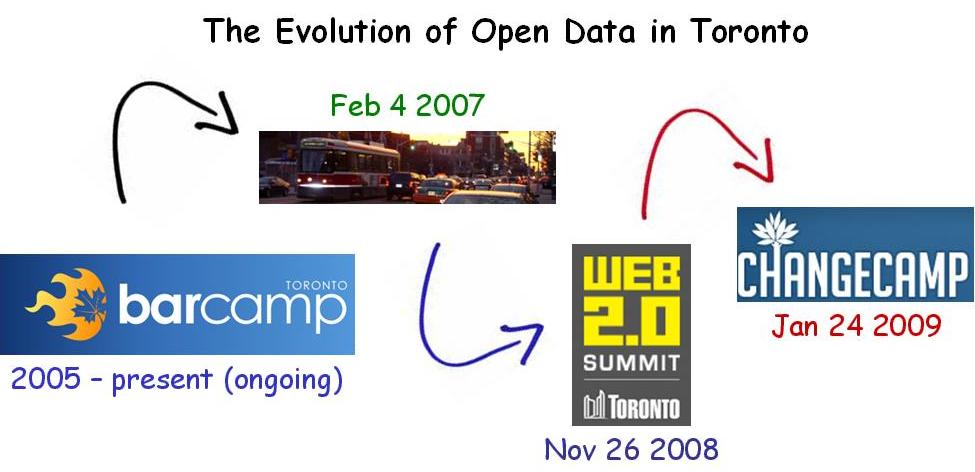
I’ve tried to map this evolution. I may have missed steps and encourage people to email me or post comments if I have.

evolution of open data TO

The first step was taken when people like David Crow created a forum – Barcamp – around which some of Toronto’s vibrant tech and social tech community began to organize itself. This not only brought the community together but it also enabled unconferences to gain traction as a fun and effective approach to addressing an issue.

Then, in late 2006 the Toronto Transit Commission (TTC) issued an Request For Proposals (RFP) for a redesign of its website. Many in the tech community – who had no interest in doing the redesign – were horrified at the RFP. It was obvious that given the specifications the new website would not achieve its potential. A community self-organized around redesigning the RFP. Others took note and, because they cared about the TTC, wanted to also talk about simple non-website changes the TTC could make to improve services. TransitCamp was this born and – with enormous trepidation, some TTC officials showed up (all of whom should be loudly applauded). The result? The tech and social tech community in Toronto was engaged in civic matters and their activities were beginning to make it onto the city government’s radar.

Other Camps carried on through 2007 and 2008 (think OpenCities), building momentum in the city. Then, in November of 2008 – a breakthrough. The City of Toronto hosted an internal Web 2.0 conference and invited Mark Surman – executive director of the Mozilla Foundation and long time participant in the Toronto social tech space – to deliver the keynote entitled “A City that Thinks like the Web“. After the talk, the Mayor of Toronto stood up and said:

” … I’ve been emailing people about your challenges. Open data for Google Transit is coming by next June, and I don’t see what we shouldn’t open source the software Toronto creates.” He also said “I promise the City will listen” if Torontonians set up a site like FixMyStreet.com

You can hear the Mayor Miller’s full response here:

In short, the Mayor promised to begin talking about opening up (and open sourcing) the city. Freeing up Ryan Merkley and the City of Toronto IT team to attend ChangeCamp

Lessons for ChangeCamp Vancouver

It remains unclear to me whether ChangeCamp is the right venue for tackling this opportunity in Vancouver.

We in Vancouver are not as far along the arc as Toronto is. We do, however, have some advantages. The map is more obvious to us and some of us have good relationships with key staff in the city. However, this process takes time. To replicate the success in Toronto, governments here on the west coast need not only be at ChangeCamp, they need to be running sessions and deeply engaged. For this to occur cultures need to be shifted, new ideas need to percolate within government institutions and agencies and relationships need to be built. All this will take time.

The creative age, the budget and the future of class conflict

Yesterday the Martin Prosperity Institute released its report Ontario in the Creative Age. I’ve been reading through it with great, great interest. The influence of Rise of the Creative Class and Who’s Your City is obvious (and expected) and the report is an important and fantastic read. Regardless of whether or not you live in the GTA/Ontario, I highly recommend it. Indeed, I would love to see the Province of British Columbia and the Metro Vancouver commission a similar report. I can imagine the methodology is now in place to do one relatively quickly, and it is urgently needed on the west coast. (Can anyone point to an economic development plan for the Greater Vancouver Area? For the City of Vancouver?)

The report also plays on a theme that has interested me for a while now. The nature of class conflict in networked and creative economy. The report tackles the issue more directly than anything else I’ve seen by Florida to date. This line from the report is illustrative:

The rise of creativity is a double-edged sword. It creates tremendous wealth creation opportunities for some. Yet it can leave many behind – particularly those in jobs built on routine, and those who do not have the opportunity to gain the skills to participate advantageously in the economic transformation we are going through.

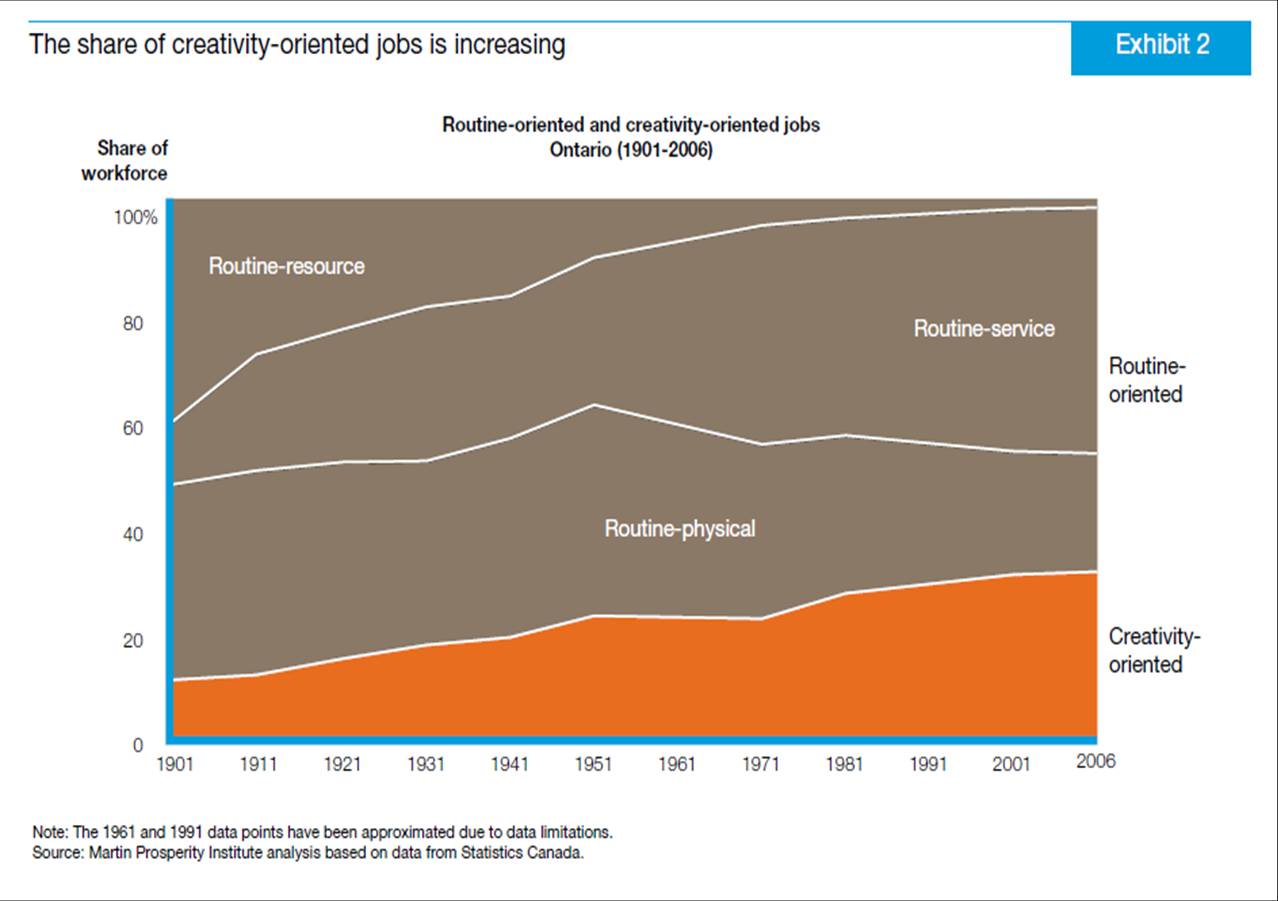
Still more interesting are the trends:
class conflict

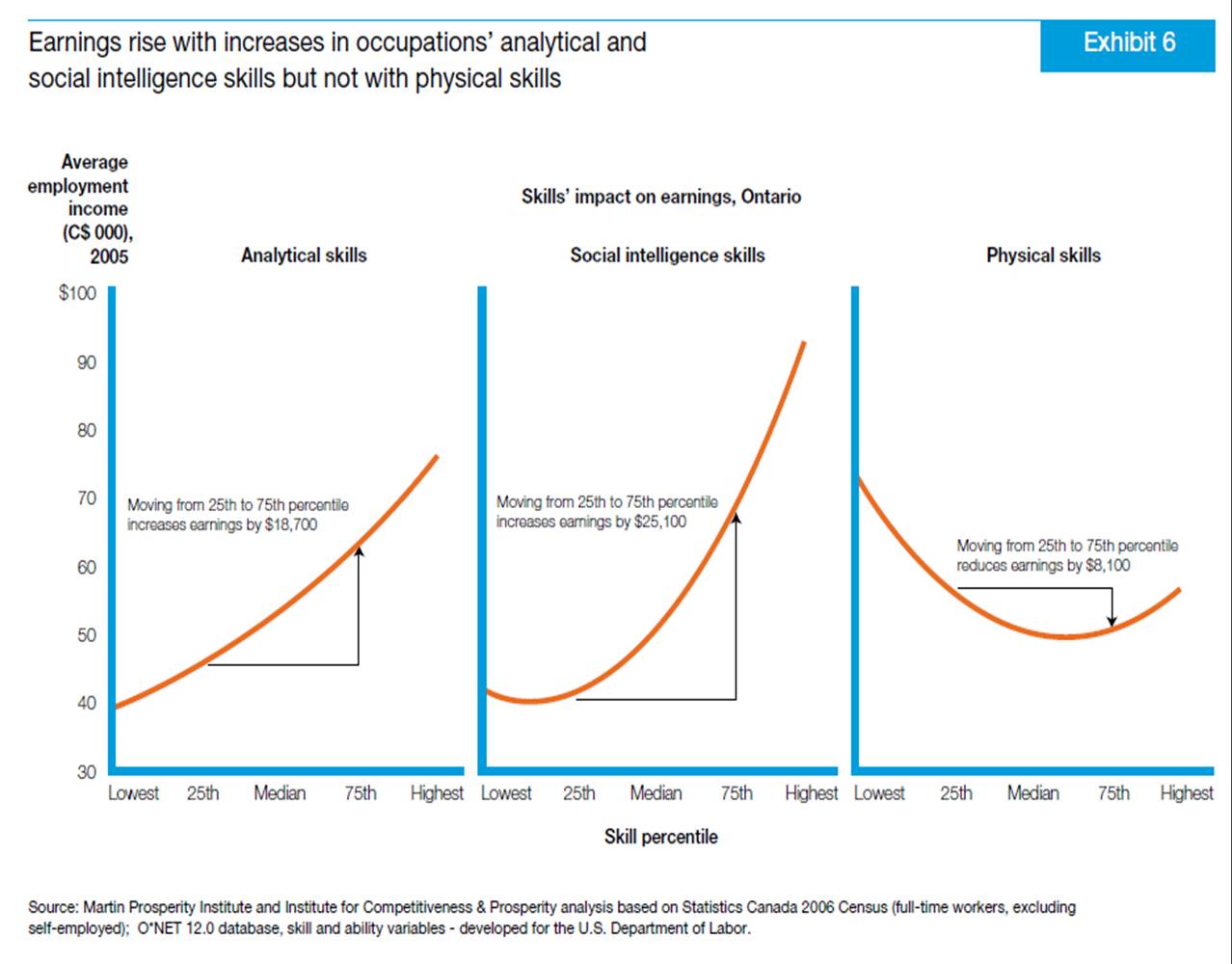
Combine this chart with there second chart that shows how wages grow depending on skill sets (no prizes for figuring out the Routine-physical-oriented jobs correlate with Physical Skills and that Social intelligence skills correlate with Creativity-Oriented jobs).

class wages

It is easy to see that the possibility of tension between routine-oriented and creativity-oriented workers could grow, especially as wage differences continue to increase.

Perhaps the most depressing conclusion to draw from this report is that the stimulus package will do little to address this inequity. A lot items that get funding in such packages (for example, some shovel ready projects) not only generate only temporary growth, but many of the jobs they foster are both becoming fewer – so we are encouraging job growth in shrinking job markets – and have a declining return on investment – so we are encouraging the development of skill-sets in workers that will not increase wages. Consequently, the very actions that traditionally might have helped stave of wage inequality (and in turn class conflict) may actually me exasperating the future likelihood of such inequality.

It’s hard to sell funding for R&D and research as these are often seen as “elite” activities, but interestingly they may offer us the greatest hope in reducing future tension and inequality. Sadly, research, science and education received little attention in the budget.

Creating a City of Vancouver that thinks like the web

Last November my friend Mark Surman – Executive Director of the Mozilla Foundation – gave this wonderful speech entitled “A City that Thinks Like the Web” as a lunchtime keynote for 300 councillors, tech staff and agency heads at the City of Toronto’s internal Web 2.0 Summit.

During the talk the Mayor of Toronto took notes and blackberried his staff to find out what had been done and what was still possible and committed the City of Toronto to follow Mark’s call to:

  1. Open our data. transit. library catalogs. community centre schedules. maps. 311. expose it all so the people of Toronto can use it to make a better city. do it now.
  2. Crowdsource info gathering that helps the city.  somebody would have FixMyStreet.to up and running in a week if the Mayor promised to listen. encourage it.
  3. Ask for help creating a city that thinks like the web. copy Washington, DC’s contest strategy. launch it at BarCamp.

The fact is every major city can and should think like the web. The first step is to get local governments to share (our) data. We, collectively as a community, own this data and could do amazing things with it, if we were allowed. Think of how Google Maps is now able to use Translink data to show us where bus stops are, what buses stop there and when the next two are coming!

Google Map Transit YVR

Imagine if anyone could create such a map, mashing up a myriad of data from local governments, provincial ministries, StatsCan? Imagine the services that could be created, the efficiencies gained, the research that would be possible. The long tail of public policy analysis could flourish with citizen coders, bloggers, non-profits and companies creating ideas, services, and solutions the government has neither the means nor the time to address.

If the data is the basic food source of such an online ecosystem then having it categorized, structured and known is essential. The second step is making it available as APIs. Interestingly the City of Vancouver appears to have taken that first step. VanMaps is a fascinating project undertaken by the City of Vancouver and I encourage people to check it out. It is VERY exciting that the city has done this work and more importantly, made it visible to the public. This is forward thinking stuff. The upside is that, in order to create VanMaps all the data has been organized. The downside is that – as far as I can tell – the public is restricted to looking at, but not accessing, the data. That means integrating these data sets with Google maps, or mashing it up with other data sets is not possible (please correct me if I’ve got it wrong).

Indeed, in VanMaps Terms of Use suggests that even if the data were accessible, you aren’t allowed to use it.

VanMaps EULA

Item 4 is worth noting. VanMap may only be used for internal business or personal purposes. My interpretation of this is that any Mashups using VanMap data is verboten.

But let’s not focus on that for the moment. The key point is that creating a Vancouver that thinks like the web is possible. Above all, it increasingly looks like the IT infrastructure to make it happen may already be in place.

Articles I'm digesting at the moment

While I keep track of the books I’m reading to the right I don’t often get to talk about the articles I’m reading and loving. Here are a few I’ve stumbled over in the past week that I’m still digesting.

1) Via Mike T, Obama and the dawn of the Fourth Republic by Michael Lind on the cycles of American progress and why the next 36 years are going to be very exciting.

During the first 36-year period of a republic, ambitious nation-builders in the tradition of Alexander Hamilton strengthen the powers of the federal government and promote economic modernization. During the second 36-year phase of a republic, there is a Jeffersonian backlash, in favor of small government, small business and an older way of life. During the backlash era, Jeffersonians manage to modify, but never undo, the structure created by the Hamiltonians in the previous era.

2) Via Alo, Why Canada has to wait for it’s Obama Moment, by Jeff Roberts. A piece few Canadians would be willing to write about why the politics of Aboriginals and the rest of Canada remain separated.

In the case of black Americans, their ascension to the political mainstream came in part from leaving behind talk of rights and identity and embracing a postracial style of politics. Barack Obama’s rise has followed his willingness to move away from the swamp of identity politics.

It’s a thesis that parallels that of Calvin Helin’s in Dances with Dependency that I thoroughly enjoyed. Moreover, Roberts is only half right. There is an emerging generation of (particularly urban) First Nations who are going to transform the politics of both the First Nations community and Canada.

3) Via Jeff A, Printing The NYT Costs Twice As Much As Sending Every Subscriber A Free Kindle by Nicholas Carlson . Shocked? You should be. As the author concludes:

Are we trying to say the the New York Times should force all its print subscribers onto the Kindle or else? No. That would kill ad revenues and also, not everyone loves the Kindle.

What we’re trying to say is that as a technology for delivering the news, newsprint isn’t just expensive and inefficient; it’s laughably so.

Besides, think of the forests that would be saved.

4) Via Amy L, The $300 Million Dollar Button, by Jared Spool. As Amy said to me, “you’re a believer in small changes” which I am. Very often I find people jump for the big lever to create big change which often creates numerous unanticipated (and almost always unwanted) changes. I’m much more interested in finding the small lever that creates big change. This piece is about precisely one of those moments in the design of a webpage.

It’s hard to imagine a form that could be simpler: two fields, two buttons, and one link. Yet, it turns out this form was preventing customers from purchasing products from a major e-commerce site, to the tune of $300,000,000 a year. What was even worse: the designers of the site had no clue there was even a problem.

Must see show this Sunday in Vancouver

It’s Friday and time to prepare for the weekend. In that spirit the perfect opportunity has arisen to both notify Vancouverites of a great cultural opportunity and give a shout out to my friend Misha Glouberman who is bringing his famous Trampoline Hall event to Vancouver! What is Trampoline Hall you ask? Look no further then the links above, the text below or the event’s facebook page:

Trampoline Hall is a barroom lecture series usually based in Toronto, but sometimes in other places. On Feb 1, it will be in Vancouver for the first time, as part of the Push Festival.

Trampoline Hall is this: Three people talk, on subjects outside their professional field of expertise. The lectures are sometimes ridiculous, sometimes moving, and always wildly unpredictable. Each talk is followed by a Q&A with the audience which is usually also a lot of fun.

Trampoline Hall was invented by the writer Sheila Heti, and is hosted by Misha Glouberman. In Toronto, it is something of an institution, playing every month for the past seven years or so. It’s also played to great crowds in around a dozen US cities, including Atlanta, Boston, New York, Louisville, Chicago, and San Francisco. Feb 1 will be Trampoline Hall’s first time in Vancouver.

All lecturers for the Vancouver show selected are selected by Veda Hille. Here is the lineup she has chosen:

1) Andrew Feldmar will talk about Cooking from Memory.
2) Kevin Chong will discuss Fraternal Polyandry
3) Faith Moosang will assert “There are Clues Everywhere!!” in a talk about Nancy Drew.

~~~~

“”Unruly… Caustically Funny” – Durham Independent

“They’ve been doing this for several years up in Toronto… now New Yorkers are in its thrall. Clearly, we love it.” – The Village Voice

“Cloud-splitting Genius” – Lola Magazine

“Eccentricity and do-it-yourself inventiveness” – The New Yorker

I’m hoping my plane lands in time so that I can make it!

To the victor go the spoils…

A while back some of you may remember that I wrote a blog post called “The Coalition that Never Was” in which I predicted:

a) the coalition would not bring down the government over the next budget

b) Layton, Dion and Harper will likely be gone within 12 months.

There were a few commentators who disagreed and one of them – Scott Ross –  wanted to place a wager over the issue (a). Namely, he believed that by today – the 29th – the coalition would bring down the government and would take office. I took him up on his offer and during subsequent negotiations (over email) the following terms were agreed to and posted in the post’s comments. Specifically:

Ok, after some offline emailing Scott and I have settled on a bet.

Scott is betting that a coalition will bring down the government on the 27th. I’m betting that it won’t.

The bet will be settled on the 28th – because either there will or will not be a new government.

The loser of this (very friendly) bet agrees to put a button linking to the winner’s blog on a prominent part of their website (likely at the top of the blog).

Today, I’m calling to collect… I hope my button can be posted shortly. I believe we agreed on a two week period for the button’s posting. I also think Scott’s been a phenomenal sport – and so am more than happy to drive traffic his way as well.

As for prediction (b) the odds feel longer but I’m still a believer – I think the first budget/coalition debacle fatally weakened pretty much all of the leaders, I wouldn’t be surprised to see Layton and Harper go down this year. I’m willing to take a friendly wager on this one too…

Lessons from the Globe and Mail's Policy Wiki

I’ve been observing the Globe Policy Wiki with enormous interest. I’m broadly supportive of all of Mathew Ingram’s experiments and efforts to modernize the Globe. That said, my sense is that this project project faces a number of significant challenges. Some from the technology, others around how it is managed. Understanding and cataloging the ups and downs of such this effort is essential. At some point (I suspect in the not too distant future) wikis will make their way into the government’s policy development process – the more we understand the conditions under which they flourish, the more likely such experiments will be undertaken successfully.

Here are some lessons I’ve taken away:

1. The problem of purpose: accuracy vs. effectiveness

Wiki’s are clearly effective at spreading concrete, specific knowledge. Software manuals, best practice lists and Wikipedia works because – more often than not – they seek to share a concrete, objective truth. Indeed “the goal” of Wikipedia is to strive for verifiable accuracy. Consequently, a Wikipedia article on Mohandas Karamchand Gandhi can identify that he was born on October 2nd, 1869. We can argue whether or not this is true, but he was born on a specific day, and people will eventually align around the most accurate answer. Same with a software wiki – a software bug is caused by a specific, verifiable, set of circumstances.  Indeed, because the article is an assemblage of facts its contributors have an easier time pruning or adding to the article.

Indeed, it is where there is debate and subjective interpretation that things become more complicated in Wikipedia. Did George Bush authorize torture? I’ll bet Wikipedia has hosted a heady debate on the subject that, as yet, remains unresolved.

A policy wiki however, lives in this complicated space. This is because the goal of a policy wiki is not accuracy. Policies are are not an assemblage of facts whose accuracy can be debated. A policy is a proposal – an argument – informed by a combination of assumptions, evidence and values. How does one edit an argument? If we share different values, what do I edit? If I have contradictory evidence, what do I change? Can or should one edit a proposal they simply don’t agree with? In Wikipedia or in online software manual the response would be: “Does it make the piece more accurate?” If the answer is yes, the you should.

But with is the parallel guiding criteria for a policy wiki? “Does it make the policy more effective?” Such a question is significantly more open to interpretation. Who defines effective?

It may be that for a policy wiki will only work within communities that share a common goal, or that at least have a common metric for assessing effectiveness. More likely, Wikis in areas such as public policy may require an owner who ultimately acts as an arbiter deciding which edits stand and which edits will get deleted.

2. Combining voting with editing is problematic.

The goal of having people edit and improve a policy proposal runs counter to those of having them vote on a proposal. A wiki is, by definition, dynamic. Voting – or any preference system – implies that what is being voted on is static and unchanging; a final product that different people can assess.  How can a user vote in favour of something if, the next day, if it can be changed into something I may disagree with it? By allowing simultaneously for voting and editing I suspect the wiki discourages both. Voters are unsure if what they are voting for will stay the same, editors were likely wary of changing anything too radically because the voting option suggests proposals shouldn’t change too much – undermining the benefits of the wiki platform.

3. While problematic for editing, the Policy Wiki could be a great way to catalog briefs

One thing that is interesting about the wiki is that anyone can post their ideas. If the primary purpose were to create a catalogue of ideas the policy wiki could be a great success. Indeed, given that people are discouraged from radically altering policy notes this is effectively what the Policy Wiki is (is it still a wiki?). Presently the main obstacle to this success is the layout. The policy briefs currently appear in a linear order based on when they were submitted. This means a reader must scroll through them one by one. There is no categorization or filtering mechanism to help readers find policies they specifically care about. A search feature would enable readers to find briefs with key words. Also, enabling users to “tag” briefs would allow readers to filter the briefs in more useful ways. One could, for example, ask to see briefs tagged “environment,” or “defense” taking you to the content you want to see faster.

Such filtering approaches might distribute readers more accurately based on their interests. In a recent blog post Ingram notes that the Flat Tax briefing note received the most page views. But this should hardly come as a surprise (and probably should not be interpreted as latent interest in a flat tax). The flat tax brief was the first brief on the list. Consequently, casual observers showing up on the site to see what it was all about were probably just clicking on the first brief to get a taste.

Which University will be smart enough to make Masoda Younasy an offer?

Yesterday, Michael Adams pointed me to this great story in the Globe and Mail about the Masoda Younasy – the granddaughter of Afghanistan’s former king, Mohammad Zahir Shah – who, because she created and ran her own construction business, advocated for reform and mused about entering politics has had death threats hurled against her.

In an extraordinary move, Canada has offered her a permit to live here while her life is at risk. A fantastic start.

So what does she want to do? According to the article:

…her aim is to attend a Canadian university and obtain a political-science degree she might some day put to use in her home country.

What an amazing opportunity. Not only for Ms. Younasy, but for Canadians and, more specifically, the university smart enough and agile enough to offer her a speedy enrollment. My own preference is that Queen’s, which is home to the Centre for the Study of Democracy, might make her an offer. Here is a women keen on bringing democracy and opportunity to a country that has seen little of either – her goals couldn’t be more aligned with those of the institution and her perspective and experience would greatly enrich the discussions in all her classes.

These are the types of opportunities that are easily missed, often because the long term opportunities and benefits – to the student, the university and the country – get trumped by bureaucracy and lack of vision. Well, for those who wonder if it is worthwhile, take note that unwittingly done something similar before and everyone was better off because of it.