Social Media Cartoons that are ha ha funny

Rob Cottingham – friend and all round wonderful person – has had his cartoon Noise to Signal syndicated on ReadWriteWeb.

I encourage all geeks and non-geeks who need a laugh (and frankly we could all laugh a little more) to go check it out.

You might also pop by the Social Signal website where two of the coolest kids in Vancouver are transforming companies (and the world!) through social media.

For those who like blogs – RSS Bandit

For PC owners who like reading blogs I’d like to point you to RSS Bandit. It’s a program I started using a couple of months ago to track and read my favourite blogs.

Obviously those of you with Macs have other software you can use, but as a PC user I’ve found RSS Bandit has been great. One of its best features is that it downloads blog posts to your computer so that you can read them offline. As many of you know I travel a fair bit and I now often get caught up on a number of my blogs while flying. Very handy. Obviously just having all your blogs in one place is itself pretty handy – better still, keeping track of the posts you’ve read and those you haven’t is also helpful.

Oh, and as a bonus, it is both free and open source.

Of course, if any of my intrepid readers have found other blogging software they like please let me know, or better yet, post a comment.

Wente’s disgraceful piece on Insite and harm reduction

Last Saturday Margaret Wente wrote this disgraceful piece on harm reduction in Vancouver.

In short, what is written is a compilation of anecdotal statements that ignore the actual research and science that has measured Insite’s positive impact. A quote from a sergeant who may or may not have an axe to grind is apparently worth more than the numerous peer reviewed articles in publications like the New England Journal of Medicine or The Lancet. This is of course Wente’s MO – she doesn’t need science or research, like Colbert her gut is her guide – something we learned long ago from her coverage of global warming.

This sadly, is not the worst of it. Wente goes on to misrepresent both the goals of Insite and the position of its advocates.

insiteNo one – least of all Insite’s advocates – believes Insite is the entirety of the solution. The goal is, and always has been to have a complete response (hence the four pillars). Insite seeks to reduce harm but it can’t ‘solve’ the drug problem alone, no one claimed it would and judging it by such a bar is misleading.

Is rehabilitation and treatment essential? Absolutely – something Insite supporters also believe. This is why OnSite (a temporary treatment facility pointedly not included in Wente’s article) was placed atop Insite so that users would have somewhere to stay while a permanent facility was found for them. Insite was never designed to replace treatment, but to reduce harm for those who refused or could not get it as well as provide a vehicle to help users seek help and get on treatment.

There are plenty of commentators I disagree with but enjoy reading because they challenge my assumptions and provoke interesting or thoughtful insights. Sadly, most of the time I read Wente I’m reminded why she’s not one of them.

Two additional points. The first is how the injection site has become an East vs. West phenomenon. Here in Vancouver the debate is over. Insite has public support, on the street, in the newspapers and in the halls of power. Even the comments in the Globe reflect a bias in favour from those commenting from Vancouver especially but BC in general.

Second, I initially wrote this in the comment section on the globe website (where one is exposed to some truly horrifying thinking) and thought nothing more of it until Andrew F. emailed me a supportive note. And I thought comments on newspaper articles were simply a cathartic exercise!

The challenge of mozilla’s magnetism

Mozilla is unique. The project gets more media, more publicity and more buzz than virtually any other open source project. It is, in much of the public’s mind, the poster child for open source and the open internet. More critically, this isn’t some interesting observation, why this is the case, and what it means, is profound implications for the success of Mozilla, the open web and the future of the internet.

I would argue that Mozilla’s uniqueness is not a result of being the most successful open source project. (I’m sure there is much heated debate over which is the most successful, largest, most complex, most important, etc… open source community/project). The fact is, it’s irrelevant.

moz-head-bigMozilla matters because Firefox is a consumer product. And not just any consumer product, it is THE consumer product that allows people to interact with the world wide web, the most consumer oriented part of the internet. Thus, while Apache, Linux, Sendmail and the million of other open source projects matter (a great deal!) the simple fact is, Mozilla is the brand that represents both the potential of open source and the importance of an open internet. This matters because it means a) Firefox and Mozilla are the catalysts in creating social awareness among millions of consumers about the importance of the open internet and b) as a result, Mozilla will likely be the first port of call of these newly awakened activists who wish to find ways to contribute.

This, of course, is both a blessing and a curse.

One the one hand it often seems that everyone, and I mean EVERYONE, has an opinion about Mozilla (and boy am I guilty of this). I’m not inside Mozilla but I can imagine the constant barrage of “helpful” ideas or suggestions or worse, outright complaints or threats, must feel exhausting. The banging on the gates never ends and engaging in it could distract the community from its important work.

On the other hand… how great that an increasing number of people have this energy and passion for Mozilla and, by extension, the open internet. Many of those banging at the gate – and a good many more who are simply too intimidated or too unsure to even do that – are primed and ready to be among the next million mozillians. The banging (or loitering) is a symptom of a desire to contribute – indeed it may be the only outlet they know of or have.

The real question is – how do we engage these people?

Should Mozilla do more to shape and lead the social movement around the open web? As David Ascher also notes, the opportunity of broadening Mozilla’s tent by absorbing these newly minted activists into streams of activities and helping channel their energy and enthusiasm is an exciting prospect. But I’m not sure the answer is a definite yes. As Mitchell Baker – in part – points out, the risk of diluting Mozilla’s mission or its culture is a serious one.

However, the social movement around the open web is going to keep attracting supporters. Again, because Mozilla is one of the leading catalyst in creating this social awareness these supporters are going to show up at it’s doorstep first. Regardless of the choice (absorb or not absorb) to successfully support the movement I’d argue that at the very minimum Mozilla needs a plan to a) greet these newcomers and make them feel welcome; and b) some capacity to point them in the direction of a variety of institutions, organizations, projects and activities, where they can channel their energy. The more people the movement can engage – or to reframe – the more communities of action with can create within our broader community of interest, the more likely we will be successful in acheiving an open internet.

mobile version of eaves.ca now available

All you readers with crack blackberries, iPhones and web-enabled cell phones, good news!

I’ve enabled a mobile version of eaves.ca! Just point your mobile browser to my blog and presto! a scaled down, simplified version of my blog will appear. The software seems solid and appears to get about 99% of the formatting right.

Of course, I can’t imagine there are a ton of you who need to get your eaves.ca fix while on the bus, but hey, I’m all about choice!

For those without such mobile devices, fear not. This will not affect non-mobile viewing of the site in any way – the site will identify if you are logging on from a mobile device or a computer and will tee up the appropriate code accordingly.

A big shout out to our friends over at WordPress mobile for making this possible.

Collaboration – a dirty word rescued by connectivity

Col·lab·o·ra·tion
n.

1. The act of working together; united labor.

2. the act of willingly cooperating with an enemy, especially an enemy nation occupying one’s own country.

During a conversation over breakfast yesterday I was asked to talk about my experience in open source public policy (through Canada25) which led me to talk about the differences between cooperation and collaboration I’ve ruminated upon before here.

After outlining the idea my friend stopped me and said

“You know, it is interesting, for people in my generation (re: boomers) collaboration was a dirty word.”

He went to explain that he’d talked with young people in his organization and had discovered that they had largely abandoned the word’s negative connotations, but he was again struck by how easily I embraced and used the term. For boomers – he explained – “collaboration” brings forward notions of Vichy France or narcs, people who sold out or who betrayed their origins in some way, often for gain or even to work (usually on behalf of) of a new (usually alien and/or evil) outsider.

What a difference a generation makes. Today I see more and more of my friends using the term. Which begs the question…

Why?

One hypothesis I have relates to the changing nature of our economy and how we work.

I don’t know if people have to work in teams more frequently then they use to, but i feel fairly confident that even if the frequency of teamwork has remained consistent, the emergent, or self-organizing, or even self-directed nature of those teams has probably increased. Thanks to the telecommunication revolution, and even just the rise of the knowledge economy, we are increasingly being asked to work together as we exchange, mix, re-mix and mash up ideas.

As a result, I think ours is a generation that is grasping for more nuanced and complex ways to describe working with others. No where is this more important than in the online world where the opportunities for both communicating, and miscommunicating, have never been easier. And within the online world nowhere is this more important than in the open source space where whole new models of how people can work together on large complex problems are emerging. With so much going on, is it any surprise our vocabulary is adjusting?

I say great. We need a more sophisticated and nuanced vocabulary to describe how we work together. The fact is people can work together in lots of different ways, conflating that variation with a single term is likely to make success harder to repeat.

Now… the revival of the word evangilism among non-religious coders is also interesting. I’ve done research as to where that came from and would be curious how it started getting used. The resistance to that word – especially given the culture wars in the US – is likely to be much greater. Outside the technology geek world that word still triggers LOTS of people.

Urban Public Transit Done Right

Metronauts, eat your hearts out. :)

Was back in Vancouver yesterday. It was a glorious day – the kind that you write in your blog about. Anyway, rode the bus downtown for several meetings and noticed this sign:

text a bus sched

In short, you can now text “33333” + the identifying number found on every bus stop in Vancouver and… the arrival times of the next 6 scheduled buses will be texted to you.

Now this schedule is probably static and does not adjust for the fact that specific buses may be running late, caught in traffic, blown a tire, etc… But it is a start.

Anything that gives transit users more information is a good thing, especially if that means it will raise their expectations around the timeliness and predictability of service (as I suspect this will). A traffic that is more demanding of its public transport is more invested in its public transport.

I can already see the logical next step… Imagine a transit user sends a text to find out when the next bus will arrive. When that bus (and possibly the subsequent bus) fails to show up he/she starts looking for a complaints or information line to call. Their expectation is going to be that the person on the other end of the line can answer the question: “Where is my bus.” The obvious conclusion to this scenario – take the GPS emitters that are on every bus and open up their API’s so that we can all see where they are. It is going to rock transit users’ worlds when they can open up google maps on their phones and search “Vancouver, Transit, 22” and see the current location of all the 22 buses.

Translink you’ve opened a pandora’s box of expectations for this user. It is a good first step.

[BTW: Transit geeks in Vancouver should already be reading this blog, which, of course, was on the case long before me. Long live the long tail of blogs.]

Fatness Index – Canada vs. United States

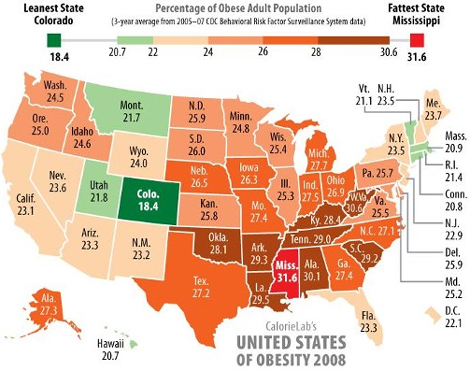
Yesterday I noticed that Richard Florida and Andrew Sullivan re-posted a map (created by calorielab) that color coded US states by the percentage of the population that was obese. I wondered if a similar map existed for Canada. Although there are several that highlight obesity – such as this one and this one – none are quite like this one. More importantly, none allowed for an easy and direct comparison between the two countries.

So I’ve taken the calorielab map, remade it, and extend it to all of North America by applying its criteria to Canadian provinces (and by using some Statistics Canada figures found here). The result is a “green armband” (of relative health) stretching across the continent.

Obese Map of NA 2

If Canadian provinces were ranked along side US States, they would rank 1st (BC), 2nd (QC), 3rd (ON), 4th (AB) and tied for 5th (MB) (YK) as the least obese provinces/states. Colorado would be the first American state placing 7th, with the provinces of NS in 8th and SK in 9th. PEI and NB would appear 15th and 16th and NFLD would appear 19th. NWT and NU would close out in 30th and 31st position. You can see the original chart at the bottom of this page.

Actually even some of the grimmer looking patches of Canada’s map have a silver lining. The Arctic Territories, specifically Nunavut (NU) and the North-West Territories (NWT), appear obese and thus unhealthy. However, Statistics Canada notes that obesity criterion for Inuit populations should be more relaxed since a high BMI does not appear to have the same health risk for Inuit as for non-Inuit. Interesting, eh?

And here is the original map I’m riffing off of…

obesitystates


Which government embraces Facebook? (hint: it's not ours)

A few weeks ago Dave D. kindly sent me this article out of England about how junior public servants are teaching their senior colleagues how to use facebook.

And just in case you think this is an ad hoc thing…

Cabinet Office minister Tom Watson yesterday said Whitehall mandarins had been given new guidelines ‘to encourage civil servants to take the first steps to engage with online social networks’.

I wonder if any Public Servant or Conservative Cabinet minister would be willing to share the same idea with our PM… likely not.

Oh, to live in a country with an open government

So the British Government doesn’t just release masses of data so the people can mash it up – they are now offering a prize to the best mash-up. Sadly, our (Canadian) government couldn’t be more secretive with it’s data.

Government EntropySure there are some low hanging fruit that I (with the help of my trusted colleague Jeremy V) was able to get and use to create this mash up of the location of government offices. Sadly, their ain’t much (that is publicly available!) to mash it up against…

Ah, the things the public would do with the data it is supposed to own and have access to, if only its government would let it…

Sometimes it’s hard not to feel like we’re uninspired, secretative and falling further, and further, behind.