Tag Archives: technology

Which App for Climate Action do you like most?

Yesterday, at 5pm PST the Apps for Climate Action team at the Province of British Columbia released the list of 17 applications created using data from the Apps for Climate Action data catalog.

At the moment anyone can register and vote for the application that they think is the best. I’d encourage people to click over to the website and take a look.

The Apps for Climate Action is a demonstration of what can happen when we begin to make government held data freely available to the public: people can bring to life, even make fun, engaging and useful, what are often boring stats and numbers to bridge what Hans Rosling calls the last 6 inches (the distance from your eyes to your brain, a reference to the failure in design where we make data we can see, but not that captures our imagination).

In a month where our federal government cited imaginary data to justify policies on crime and has eliminated the gathering a huge swaths of effective data necessary for the efficient governing of our cities and rural communities as well as ensuring critical services will no longer reach innumerable Canadians, it is nice to see a province trying to do the opposite: not only understand that effective data is the cornerstone to good policy but to enable everyday, ordinary Canadians to leverage it so as to make smarter decisions, influence policy debates and empower themselves. It’s what a modern democracy, economy and civil society should look like.

The Apps for Climate action team and the government deserve a ton of praise fro striking out and trying something new and different. I hope they get worthwhile acknowledgement.

I for one am looking forward to the tough job of serving as a judge in the competition.

On Governments and Intellectual Property (or why we move slowly)

David H. sent me this short and fantastic article from Wired magazine last week.

The article discusses the travails of Mathew Burton, a former analyst and software programmer at the Department of Defense who spent years trying to get the software he wrote into the hands of those who desperately needed it. But alas, no one could figure out the licensing rights for the software it was supposed to work with… so it never went anywhere. Today Mathew has (unsurprisingly) left Defense and has open sourced the code so that anyone can use it. The lesson? The tangled mess of navigating all the license agreements isn’t protecting anyone and certainly not the public. It’s just preventing interesting new and derivative works from being used to render American safer.

In short, the crises here doesn’t have to do with size of government, but in a misplaced desire by many governments to protect “intellectual property.”

Now I understand the need of government to protect physical property. A forest, for example, can only be logged once every few generations, so allocating that resource efficiently matters. But intellectual property? Things like documents, data, and software code? It’s use is not diminished when someone uses it. Indeed, often its value increases when numerous people start to use it.

But rather than give to tax payers the intellectual property their tax dollars already paid for, our governments lock them down. Today, under the false belief that they are protecting themselves and potential revenue streams (that have never materialized) our governments copyright, patent and license all sorts of intellectual property our tax dollars paid for. In short, we treat ideas like we treat forests, something that only a handful of people can use and benefit from.

This has three happy consequences.

First, ideas and innovations are more expensive and spread more slowly. Remember the goal of innovation is not to license technology, its to use technology to enable us to be happier, safer or more productive (or ideally all three!). When our governments license technology that accomplishes one or all of these things they are, in fact, restricting the number of people who can benefit by giving a single actor a monopoly to sell this service (again, one tax payers funded to develop!) to tax payers or (worse) back to the government.

Second, we end up wasting a colossal amount of money on lawyers. With our governments pretending to be a corporation, managing all this intellectual property tax payers funded to develop, we naturally require an army of lawyers to protect and license it!

Finally, many governments are locked out of open source projects and communities. Since, by policy, many governments require that they own any code they, or their contractors develop, they cannot contribute to open source projects (in which the code is by definition, not owned but shared). This means free, scalable and customizable software and products that small companies like Google are forbidden within government. Instead they (and by they, I mean us) have to pay for proprietary solutions.

At some point I’d love to read more about how government got into the intellectual property businesses. I imagine it is a history paved with good intentions. However, the more I reflect on it, the more I wonder why the first order question of “why do governments have intellectual property” never gets asked. The costs are high and the benefits seem quite low. Maybe it’s time we radically rethink this.

The Web and the End of Forgetting: the upside of down

A reader recently pointed me to a fantastic article in the New York Times entitled The Web and the End of Forgetting which talks about the downside of a world where one’s history is permanently recorded on the web. It paints of the dangers of a world where one can never escape one’s past – where mistakes from college rear their head in interviews and where bad choices constrain the ability to start anew.

It is, frankly, a terrifying view of the world.

I also think it is both overblown and, imagines a world where the technology changes, but our social condition does not. Indeed, the reader sent me the piece because it reminded him of a talk and subsequent blog post I wrote exactly a year ago on the same topic.

But let’s take the worse case scenario at face value. While the ability to start anew is important, at times I look forward to a world where there is a little more history. A world where choices and arguments can be traced. A world of personal accountability.

Broadcast media fostered a world where one could argue one position and then, a few months later, take the exact opposite stand. Without easily accessible indexes and archives discerning these patterns was difficult, if not impossible. With digitization, that has all changed.

The Daily Show remains the archetype example of this. The entire show is predicated on having a rich archival history of all the major network and cable news broadcasts and having the capacity, on a nightly basis, to put the raw hypocrisy of pundits and politicians on display.

The danger of course, is if this is brought to the personal level. The NYT article identifies and focuses on them. But what of the upsides? In a world where reputation matters, people may become more thoughtful. It will be interesting to witness a world where grandparents have to explain to their grandchildren why they were climate change deniers on their Facebook page. Or why you did, or didn’t join a given political campaign, or protest against a certain cause.

Ultimately, I think all this remembering leads to a more forgiving society, at least in personal and familial relationships, but the world of pundits and bloggers and politicans may become tougher. Those who found themselves very much on the wrong side of history, may have a hard time living it down. The next version of the daily show may await us all. But not saying anything may not be a safe strategy either. Those who have no history, who never said anything at anytime, may not be seen relevant, or worse, could be seen as having no convictions or beliefs.

I loved the New York Times article, but it looked at society as a place where social values will remain unchanged, where we won’t adapt to our technology and place greater emphasis on new values. I can imagine a world where our children may say – how did you have friends with so little personal history? It may not be our ideal world, but then, our grandparents world wasn’t one I would have wanted to live in either.

Creating Open Data Apps: Lessons from Vantrash Creator Luke Closs

Last week, as part of the Apps for Climate Action competition (which is open to anyone in Canada), I interviewed the always awesome Luke Closs. Luke, along with Kevin Jones, created VanTrash, a garbage pick up reminder app that uses open data from the City of Vancouver. In it, Luke shares some of the lessons learned while creating an application using open data.

As the deadline for the Apps for Climate Action competition approaches (August 8th) we thought this might help those who are thinking about throwing their hat in the ring last minute.

Some key lessons from Luke:

  • Don’t boil the ocean: Keep it simple – do one thing really, really well.
  • Get a beta up fast: Try to scope something you can get a rough version working in day or evening – that is a sure sign that it is doable
  • Beta test: On friends and family. A lot.
  • Keep it fun: do something that develops a skill or let’s you explore a technology you’re interested in

Awesome Interactions: More on my Mozilla Summit 2010 Ignite Talk

Last week I had the distinct pleasure of being at the Mozilla Summit.

This is a gathering of about 650ish people from innumerable countries around the world to talk about Mozilla, the future of the open web, the various Mozilla products (such as Firefox and Thunderbird). As Mozilla is a distributed community of thousands of people from around the world and the summit only takes place every two years, it as one participant memorably put it, “an opportunity to engage in two years of pent up water cooler talk.”

As a follow up for the summit I’ve two things I wanted to share.

First, for those who enjoyed my Ignite talk on community management entitled Making the Army of Awesome More Awesome I’ve uploaded my slides to slideshare. (Not the most flattering picture of me giving the talk, but the only one I could find on flickr…)

I’m hoping, once the summit organizers have taken a much deserved break, to get video and audio of the presentation and I’ll create slidecast and post it to this blog.

Also, if you found the talk engaging, there is a longer version of that talk where I dive a little deeper into some of the theory I mention at the end. It is a talk David Humphrey kindly asked me to give back at FSOSS a few yeas ago called Community Management: Open Source’s Core Competency.

Second, both in my talk and during the incredible time I had speaking with a number of people in the Mozilla community I brainstormed a ton of ideas. I’m committed to documenting those and sharing them. Here’s a list of some of them, in the coming week I hope to blog on each, and ideally all of these.

1. Improve the link between Bugzilla and SUMO

2. Auto-generate help topics in the Help pull down menu

3. Ask people when they download Firefox or Thunderbird if they’ll volunteer to do bug confirmation

4. Add “Newbie” to new Bugzilla registers

5. Add “ESL” (English as a second language) to Bugzilla accounts that request it

6. Rethinking data.mozilla.org and fostering a research community

7. Segment Bugzilla submitters into groups that might be engaged differently

8. Reboot Diederik Van Liere’s jet pack add-on that predicts bug patch success

8b. Add on a crowdsourcing app to call out negative language or behaviour

9. Retool questions asked in Bugzilla to “nudge” users to better responses

10. Develop an inquire, paraphrase, acknowledge and advocate crowdsourcing identfier jet pack add on for bugzilla

11. plus more, but lets start with these…

Minister Moore and the Myth of Market Forces

Last week was a bad week for the government on the copyright front. The government recently tabled legislation to reform copyright and the man in charge of the file, Heritage Minister James Moore, gave a speech at the International Chamber of Commerce in which he decried those who questioned the bill as “radical extremists.” The comment was a none-too-veiled attack at people like University of Ottawa Professor Michael Geist who have championed for reasonable copyright reform and who, like many Canadians, are concerned about some aspects of the proposed bill.

Unfortunately for the Minister, things got worse from there.

First, the Minister denied making the comment in messages to two different individuals who inquired about it:

Still worse, the Minister got into a online debate with Cory Doctorow, a bestselling writer (he won the Ontario White Pine Award for best book last year and his current novel For the Win is on the Canadian bestseller lists) and the type of person whose interests the Heritage Minister is supposed to engage and advocate on behalf of, not get into fights with.

In a confusing 140 character back and forth that lasted a few minutes, the minister oddly defended Apple and insulted Google (I’ve captured the whole debate here thanks to the excellent people at bettween). But unnoticed in the debate is an astonishing fact: the Minister seems unaware of both the task at hand and the implications of the legislation.

The following innocuous tweet summed up his position:

Indeed, in the Minister’s 22 tweets in the conversation he uses the term “market forces” six times and the theme of “letting the market or consumers decide” is in over half his tweets.

I too believe that consumers should choose what they want. But if the Minister were a true free market advocate he wouldn’t believe in copyright reform. Indeed, he wouldn’t believe in copyright at all. In a true free market, there’d be no copyright legislation because the market would decide how to deal with intellectual property.

Copyright law exists in order to regulate and shape a market because we don’t think market forces work. In short, the Minister’s legislation is creating the marketplace. Normally I would celebrate his claims of being in favour of “letting consumers decide” since this legislation will determine what these choices will and won’t be. However, the Twitter debate should leave Canadians concerned since this legislation limits consumer choices long before products reach the shelves.

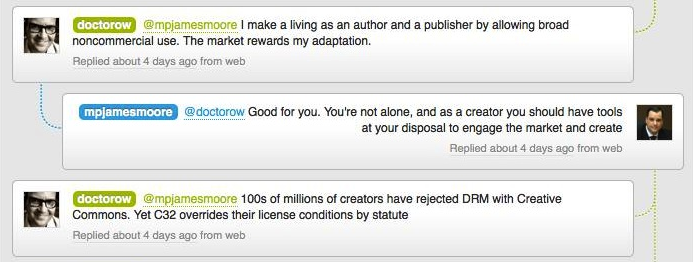
Indeed, as Doctorow points out, the proposed legislation actually kills concepts created by the marketplace – like Creative Commons – that give creators control over how their works can be shared and re-used:
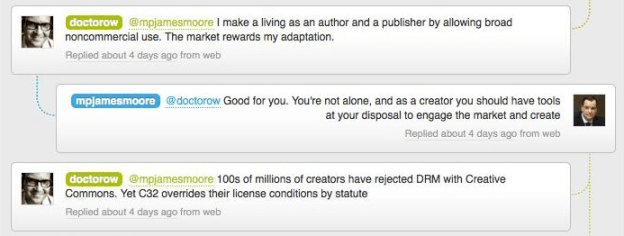
But advocates like Cory Doctorow and Michael Geist aren’t just concerned about the Minister’s internal contradictions in defending his own legislation. They have practical concerns that the bill narrows the choice for both consumers and creators.

Specifically, they are concerned with the legislation’s handling of what are called “digital locks.” Digital locks are software embedded into a DVD of your favourite movie or a music file you buy from iTunes that prevents you from making a copy. Previously it was legal for you to make a backup copy of your favourite tape or CD, but with a digital lock, this not only becomes practically more difficult, it becomes illegal.

Cory Doctorow outlines his concerns with digital locks in this excellent blog post:

They [digital locks] transfer power to technology firms at the expense of copyright holders. The proposed Canadian rules on digital locks mirror the US version in that they ban breaking a digital lock for virtually any reason. So even if you’re trying to do something legal (say, ripping a CD to put it on your MP3 player), you’re still on the wrong side of the law if you break a digital lock to do it.

But it gets worse. Digital locks don’t just harm content consumers (the very people people Minister Moore says he is trying to provide with “choice”); they harm content creators even more:

Here’s what that means for creators: if Apple, or Microsoft, or Google, or TiVo, or any other tech company happens to sell my works with a digital lock, only they can give you permission to take the digital lock off. The person who created the work and the company that published it have no say in the matter.

So that’s Minister Moore’s version of “author’s rights” — any tech company that happens to load my books on their device or in their software ends up usurping my copyrights. I may have written the book, sweated over it, poured my heart into it — but all my rights are as nothing alongside the rights that Apple, Microsoft, Sony and the other DRM tech-giants get merely by assembling some electronics in a Chinese sweatshop.

That’s the “creativity” that the new Canadian copyright law rewards: writing an ebook reader, designing a tablet, building a phone. Those “creators” get more say in the destiny of Canadian artists’ copyrights than the artists themselves.

In short, the digital lock provisions reward neither consumers nor creators. Instead, they give the greatest rights and rewards to the one group of people in the equation whose rights are least important: distributors.

That a Heritage Minister doesn’t understand this is troubling. That he would accuse those who seek to point out this fact and raise awareness to it as “radical extremists” is scandalous. Canadians have entrusted in this person the responsibility for creating a marketplace that rewards creativity, content creation and innovation while protecting the rights of consumers. At the moment, we have a minister who shuts out the very two groups he claims to protect while wrapping himself in a false cloak of the “free market.” It is an ominous start for the debate over copyright reform and the minister has only himself to blame.

Canadian Open Cities Update

For those who have not been following the news there have been a couple of exciting developments on the open data front at the municipal level in Canada.

First off, the City of Edmonton has launched its Apps competition, details can be found at the Apps4Edmonton website.

Second, it looks like the City of London, Ontario is may do a pilot of open data – thanks to the vocal activism of local developers and community organizers the Mayor of London expressed interesting in doing a pilot at the London Changecamp. As mentioned, there is a vibrant and active community in London, Ontario so I hope this effort takes flight.

Third, and much older, is that Ottawa approved doing open data, so keep an eye on this website as things begin to take shape

The final municipal update is the outlier… Turns out that although Calgary passed a motion to do open data a few months ago the roll out keeps getting delayed by a small group of city councillors. Reasons are murky especially since I’m told by local activists that the funds have already been allocated and that everything is set to go. Will be watching this unfold with interest.

Finally, unrelated to municipal data, but still important (!), Apps4Climate Action has extended the contest deadline due to continued interest in the contest. The new submission deadline is August 8th.

Hope everyone has a great weekend. Oh, and if you haven’t already, please join the facebook group “let’s get 100,000 Canadian to op out of yellow pages delivery.” Already, in less than a week, over 800 Canadians have successfully opted of receiving the yellow pages. Hope you’ll join too.

The Myth of the Open Data Mob: a response to Mike Ananny

I recently discovered that Mike Ananny wrote this response to a piece I initially posted here and then on The Mark titled Let Us Audit Parliament’s Books. I encourage you to read both my piece and Ananny’s thoughtful response. And, in the spirit of dialogue, I have two thoughts in response.

First, Ananny misrepresents the thrust of my argument. He suggests that I only want crowds and that my goal is to replace public institutions with amorphous “crowds.” Nothing could be further from the truth. Indeed, I say, at the end of the article, that the Auditor General should do her own audit – using the same information that is available to everyone. I’m not in favour of replacing institutions with crowds, or democracy with populism. What I am in favour of is ensuring their are checks on institutions.

Second, Ananny creates a straw man of my arguments painting the picture of a single monolithic crowd. These misrepresentation can be found in lines such as this from his piece:

It’s okay that we do this. But in the kind of crowd-sourced audit Eaves describes, who are the “others” that we trust to discover on our behalf and teach us what they learn? At least we know who the auditor general is and how – cumbersome as it might be – she and the government can be replaced.

This is certainly not what I sought to describe nor is what I think I did, but as an author I share responsibility in being clear.

Do I believe there will be no single amorphous crowd? No. I believe there will be the public much like today. And it will discern the debate in the same way it currently does. What does this mean? I suspect that if the expensess were public there might be numerous audits, and that those will find it easiest to earn the public’s trust will be those conducted by “others” who first and foremost declare who they are. The most obvious candidate for this would be the Globe and Mail. (Wouldn’t it be nice if they had access to MP expenses)? Of course, the Globe may not have the resources to go through every line of every MP’s expenses so they may ask people to flag lines that seem to be of particular importance. This is, of course, how  The Guardian newspaper in the UK exposed some of the most problematic expenses in their MP expense scandal. In short, this isn’t a single faceless mob, this is about allowing numerous people, from public institutions to the media to self interested private citizens. Some will self-organize, others will not. But there will be a diversity of perspectives.

Second, and more importantly, is that these competing audits would be good for democracy and for public institutions. I completely agree with Ananny’s quote from Bentham. A perfectly knowledgeable public is a myth. Yes, most of us, on most issues, knowingly or not, do delegate responsibility for forming our beliefs to others. The challenge is, to whom to delegate? Ananny seems confident he knows exactly who it should be (an AG who, actually, only has the power to shame). He wants us to place our faith in a crowd of one – the AG – who no one gets to choose and who herself has no oversight.  I’m interested in a different outcome. We live in a world where it is easier to allow more than one resource to which citizens can delegate their trust. More importantly, by sharing the expenses different parties can assess how others conduct their audit – biases, different assumptions, flaws and more clear comparisons – in short a public debate, could take place. Giving everyone access to MP expenses will, admittedly, be messy, but then so is democracy. The point is you either believe in public debate or you don’t.

Encouragingly, this is ultimately what Ananny seems to want as well, as he states:

I know we don’t have to choose between crowds or experts – I want both – but if it’s a question of emphasis, I’d much rather be the constituent of an AG who can be legally reprimanded and dramatically fired than an unwilling patron of a crowd that may or may not know what it’s doing.

I want both as well. I’d also love to see a supportive infrastructure that helps people contribute to audits. Indeed, this was the thrust of my June 10th piece Learning from Libraries: The Literacy Challenge of Open Data. But you don’t create that infrastructure by not sharing the the accounts openly. As my libraries piece argues, sharing is a precondition to developing such an infrastructure.

So if, as suggested, this is a question of emphasis, why did Ananny choose to use my piece as a launchpad for his own? We seem to be on the same page (we both appear to want to improve public institutions and public debates). I think the ultimate reason lies in this last point. Ananny’s examples refer to crowds or institutions that are deemed expert by somebody. But the public’s trust in an institution or resource or even a crowd isn’t granted or ordained, it is earned. Ananny’s solutions keep returning to the notion that we need to ordain trust and delegate whereas mine is that we need to enable emergent systems so that many actors can attempt to earn trust and we can debate. This is why I agree that the AG’s office should, as he suggests, provide a program to help people learn how to do audits. But I also I think society will be best served when a diversity (of particularly emergent) approaches are possible, perhaps involving actors like accounting firms and universities. This would allow others to be a check on the AG which will enhance, not destroy confidence. But again, this is only possible if we all have access to the information.

And that ultimately is my point. Access to information is a precondition that enables us to engage in better debates, foster systems that support alternative perspectives and also provides a check on public institutions. It is these checks and debate, not blind delegation, that will improve confidence.

War makes facists of us all: Would you like to know more?

Starship_TroopersOver the years I’ve taken my lumps from friends for loving Starship Troopers. Most who haven’t seen it assume it is a dumb sci-fi action movie. But listen to the directors commentary and the first two things you’re told is that the movie is about “how war makes fascists of us all” and that the Federal Network “media sequences” are based on US World War II anti-Japanese propaganda films. Now that’s dark.

How dark? Well, I’ve always felt that Starship Troopers was to the film medium what 1984 was to books. Yes both are sci-fi, but more importantly they are bleak looks into how technology and power can merge to create a nightmare future (indeed, on a wild tangent, 1984 may be one of the best arguments for why we need an open web).

So if you’ve never thought of Starship Troopers that way (or any way!) I can’t say enough good things about Scott Tobias’ revisit and analysis of the movie 13 years later. It is brilliant.

In fact, stop reading me, go read him.

Not only a far better articulation than anything I’d have written but it also goes places I’d never gone: Tobias’ observation that Starship Troopers is an allegory for September 11th before it happened is brilliant.

As an aside I also love Tobias’ analysis of Starship Troopers faux network television/internet – the Federal Network:

Yet the key to the Federal Network’s power isn’t necessarily the clips themselves—which feature such great cultural advancements as televised executions (after whiplash-swift justice) and barely censored “censored” violence—but the prompt at the end, “Would you like to know more?” That’s what makes it effective as propaganda: the illusion of knowledge, the illusion of choice, the illusion that people have control over their own destinies.

Sometimes that feels exactly like what we get from CNN/MSNBC and especially FOX News… but then willingly or unwillingly, in the first decade of the 21st century war has already made fascists of us all.

Learning from Libraries: The Literacy Challenge of Open Data

We didn’t build libraries for a literate citizenry. We built libraries to help citizens become literate. Today we build open data portals not because we have public policy literate citizens, we build them so that citizens may become literate in public policy.

Yesterday, in a brilliant article on The Guardian website, Charles Arthur argued that a global flood of government data is being opened up to the public (sadly, not in Canada) and that we are going to need an army of people to make it understandable.

I agree. We need a data-literate citizenry, not just a small elite of hackers and policy wonks. And the best way to cultivate that broad-based literacy is not to release in small or measured quantities, but to flood us with data. To provide thousands of niches that will interest people in learning, playing and working with open data. But more than this we also need to think about cultivating communities where citizens can exchange ideas as well as involve educators to help provide support and increase people’s ability to move up the learning curve.

Interestingly, this is not new territory.  We have a model for how to make this happen – one from which we can draw lessons or foresee problems. What model? Consider a process similar in scale and scope that happened just over a century ago: the library revolution.

In the late 19th and early 20th century, governments and philanthropists across the western world suddenly became obsessed with building libraries – lots of them. Everything from large ones like the New York Main Library to small ones like the thousands of tiny, one-room county libraries that dot the countryside. Big or small, these institutions quickly became treasured and important parts of any city or town. At the core of this project was that literate citizens would be both more productive and more effective citizens.

But like open data, this project was not without controversy. It is worth noting that at the time some people argued libraries were dangerous. Libraries could spread subversive ideas – especially about sexuality and politics – and that giving citizens access to knowledge out of context would render them dangerous to themselves and society at large.  Remember, ideas are a dangerous thing. And libraries are full of them.

Cora McAndrews Moellendick, a Masters of Library Studies student who draws on the work of Geller sums up the challenge beautifully:

…for a period of time, censorship was a key responsibility of the librarian, along with trying to persuade the public that reading was not frivolous or harmful… many were concerned that this money could have been used elsewhere to better serve people. Lord Rodenberry claimed that “reading would destroy independent thinking.” Librarians were also coming under attack because they could not prove that libraries were having any impact on reducing crime, improving happiness, or assisting economic growth, areas of keen importance during this period… (Geller, 1984)

Today when I talk to public servants, think tank leaders and others, most grasp the benefit of “open data” – of having the government sharing the data it collects. A few however, talk about the problem of just handing data over to the public. Some questions whether the activity is “frivolous or harmful.” They ask “what will people do with the data?” “They might misunderstand it” or “They might misuse it.” Ultimately they argue we can only release this data “in context”. Data after all, is a dangerous thing. And governments produce a lot of it.

As in the 19th century, these arguments must not prevail. Indeed, we must do the exact opposite. Charges of “frivolousness” or a desire to ensure data is only released “in context” are code to obstruct or shape data portals to ensure that they only support what public institutions or politicians deem “acceptable”. Again, we need a flood of data, not only because it is good for democracy and government, but because it increases the likelihood of more people taking interest and becoming literate.

It is worth remembering: We didn’t build libraries for an already literate citizenry. We built libraries to help citizens become literate. Today we build open data portals not because we have a data or public policy literate citizenry, we build them so that citizens may become literate in data, visualization, coding and public policy.

This is why coders in cities like Vancouver and Ottawa come together for open data hackathons, to share ideas and skills on how to use and engage with open data.

But smart governments should not only rely on small groups of developers to make use of open data. Forward-looking governments – those that want an engaged citizenry, a 21st-century workforce and a creative, knowledge-based economy in their jurisdiction – will reach out to universities, colleges and schools and encourage them to get their students using, visualizing, writing about and generally engaging with open data. Not only to help others understand its significance, but to foster a sense of empowerment and sense of opportunity among a generation that could create the public policy hacks that will save lives, make public resources more efficient and effective and make communities more livable and fun. The recent paper published by the University of British Columbia students who used open data to analyze graffiti trends in Vancouver is a perfect early example of this phenomenon.

When we think of libraries, we often just think of a building with books.  But 19th century mattered not only because they had books, but because they offered literacy programs, books clubs, and other resources to help citizens become literate and thus, more engaged and productive. Open data catalogs need to learn the same lesson. While they won’t require the same centralized and costly approach as the 19th century, governments that help foster communities around open data, that encourage their school system to use it as a basis for teaching, and then support their citizens’ efforts to write and suggest their own public policy ideas will, I suspect, benefit from happier and more engaged citizens, along with better services and stronger economies.

So what is your government/university/community doing to create its citizen army of open data analysts?