Tag Archives: canadian politics

Reforming Government on the Globe & Mail's Wiki

A few months ago John Ibbitson – the Globe and Mail columnist who used to cover Ottawa and now covers Washington, DC – asked me if I’d help edit the 3rd chapter of his new book, Open & Shut.

The chapter, entitled Yes, Mr. President; No, Prime Minister asks why is it that after 8 years of President Bush, President Obama is able to quickly change the direction of government whereas in Canada, newly elected parties often struggle to implement their agenda.

Last week the book was released. As part of the launch process the Globe and Mail created a wiki dedicated to the book’s themes where readers can critic or expand on its ideas and analysis. More interestingly, as readers post to the wiki John will respond to their  ideas, critics and thoughts on a blog hosted by the Globe.

To kick off the wiki on Open Government, John asked me if I would write a short essay answering the following the question:

Federal politicians, and federal public servants, seem increasingly remote and disconnected from the lives of Canadians. Open and Shut maintains that this is because the public service remains closed to outsiders, and because Ottawa has ceded so much power to the provinces. Do we want our federal government to matter more in our lives, and if so, what should we do to give it meaning?

You can see my response, and what I hope will eventually become a growing number of comments on the future of the public service, here.

As an aside, two other sections have been created. One is on Open Politics, which is teed up by John Duffy (political strategist). The other is on Canada/US integration, which is kicked off by Scotty Greenwood (executive Director of the Canadian-American Business Council).

RCMP and Vatican: The downfall of hierarchical and opaque organizations

I’m on the road which is basically the only time I watch TV news and was pleased that I did this evening since I caught Terry Milewski’s excellent follow up piece on the how the RCMP has dealt (or in this case, not dealt) with investigating its own officers over the death of Polish traveler Robert Dziekanski.

The thing that really struck me about Milewski’s story was how much it appeared to suggest that the RCMPs method for dealing with problematic individuals parallels that of the Vatican’s. In the 70’s, 80’s and 90’s the Vatican regularly moved priests it knew was molesting children from diocese to diocese. Priests like Father John Gagan, who molested dozens and dozens of people were never suspended or ordered to take treatment. They were simply shuffled around and the problem was covered up.

The retired RCMP officers in Milewski’s piece suggest that a similar practice occurs within the RCMP. For example, one of the officers involved in the death of Robert Dziekanski, Corporal Benjamin Robinson (who subsequently, has allegedly been involved in a drinking and driving incident which resulted in a death and in which he fled the scene) has apparently experienced a number of challenges in his previous posts. The point here is not to assess Corporal Robinson, but a system that promoted and moved him around rather than offer him needed support.

What is most scary for Canadians is that the RCMP does not appear to understand how quickly the public’s loss of faith could grow and thus manifest into a real crises of confidence in the organization. Consider the recent past of RCMP scandals:

In isolation, each scandal is not a problem. Collectively, given people’s capacity to use the internet to create coalitions and mobilize, resistance to bureaucratic, authoritarian and opaque institutions can crystallize very, very quickly.

Clay Shirky offers one of the best examples of this in his book, Here Comes Everybody where he talks about the rise of Voice of the Faithful – a catholic protest group formed in reaction to the pedophile priest scandal in 2002. Here is Shirky discussing the issue in an interview:

Because in 2002, Father John Gagan, a pedophile priest in Boston, was brought to trial and The Boston Globe covered the story. And during the course of this trial and then the subsequent outrage, this little group formed in a basement in January, called Voice of the Faithful. It was basically outraged Catholics who wanted to do something.

By that summer, they went from 30 people in a church basement to 25,000 members in 21 countries around the world. Now, groups don’t grow that fast, or they didn’t prior to the Internet.

And one of the really remarkable things that I think demonstrated how quickly the Catholic outrage solidified into this reaction – and Voice of the Faithful was instrumental in both changing Vatican policy but also getting several high-level bishops and archbishops to resign their posts because of the bad handling of the pedophile scandal.

The Catholic Church very much wanted to say, this is a one-off. This is an unusual case. But, in fact, almost exactly 10 years before, in 1992, something almost identical happened. In that case, the priest’s name was Porter. But it took place in the same diocese in Massachusetts. Bishop Law was the same person in charge. The Boston Globe was the same newspaper reporting.

But in that case, it just blew over. Part of the difference between ’92 and 2002, which is to say, between failure to reform the Church and at least partial success in reforming the Church, is that in ’92 The Boston Globe wasn’t really global. It was a local paper. There was no way for coverage in the Boston area to suddenly become of global importance.

The other part of the story is that it isn’t just about consuming media. It’s actually about doing something about it. Everybody who read about Voice of the Faithful in one of these stories could join online, they could make a donation immediately, and that changed from a big gap between thought and action in ’92 to a very small gap between thought and action in 2002.

Canadians are increasingly losing faith in the RCMP. And much like many Boston Catholics lost faith in the Vatican, they should be. It is an organization fraught with challenges, that has little, or at least very poor, civilian oversight.

The problem for the RCMP is that, increasingly, Canadians have the capacity to mobilize over this issue and the organization’s response to challenges to its authority have not been well received. Today, a rag tag and splintered group of people ranging from anti-rape activists, first nation advocates, the polish community, human and citizen right advocates and harm reduction advocates could be the proverbial 30 people in a basement Shirky talks about in his Voice of the Faithful example. When those concerned with the RCMP coalesce, it may appear to happen quickly and grow exponentially. My hope remains that the RCMP addresses its issues before this happens. My fear, is that without pressure, it won’t.

Ultimately, authoritarian and opaque institutions such as the RCMP and the Vatican will continue to have relevance in a world of networked enabled citizens, but I suspect that their freedom to operate unobserved and unquestioned will become increasingly constrained. Another painful transition is ahead, but one that is long overdue and necessary.

Why voting is like eating ice cream

In the past I’ve posted about how I believe that voting should be more convenient, and that this could help start a virtuous loop that might lead more young people to vote. Specifically, I’ve lamented that we have a voting system that concentrates voting stations in community centres, churches and schools – places that are out of the way and/or not on common commuting paths for many young people.

People can complain that young people are lazy. Maybe they are – but so what? In an era where things are available at the click of a mouse young people are accustomed to a different level of convenience. You might wish they were willing to walk through the snow for a kilometer or two to vote, but by and large they aren’t. Does this mean that I don’t think we should try to encourage people to care about voting more – absolutely not, I’m a huge fan of groups like Student Vote. But I believe that there may be some quick – more readily achieved – and cheaper wins in designing voting systems for lazy people. This would certainly be easier than trying to make people less lazy.

I’ve recently started following the blog by the authors of Nudge, since I’m a big fan of figuring out how we can passively design systems to that encourage people to adopt “good” behaviours. Recently they pointed to a food/diet blog that outlined the conclusions of the following (sadly uncited) experiment:

“One cafeteria tested (how much effort people will go to to eat ice cream) by leaving the lid of an ice cream cooler closed on some days and open on other days. The ice cream cooler was in the exact same location, and people could always see the ice cream.  All that varied was whether they had to go through the effort of opening the lid in order to get it.  Even that was too much work for many people.  If the lid was closed, only 14% of the diners decided it was worth the modest effort to open it.  If the lid was open, 30% decided it was ice cream time.”

Essentially, this tiny shift doubled the number of people who chose ice cream. Rather than designing new (complicated) ways of voting, this is where I’d like to start. What are the small things we can do around voting to make it easier, to “nudge” people to make the civically minded choice? Voting booths in more places – and nicer places, say the local coffee shop? In the mall? Or how about on the street corner? And then of course, there is the postal voting (that actually comes on time and works) and the holy grail of on-line voting (with all of its dangerous identity implications).

Either way, let’s think about how we can re-engineer voting and make it easier for those of us born in the 20th (not to mention 21st) century. We could castigate and hate ourselves for being lazy – or we can design an easier way to vote, one that will nudge us towards a behaviour people seem to think is good. I know I’d rather spend my energy on the latter.

Articles I'm digesting 6/2/2009

The Quiet Unravelling of Canadian Democracy by James Travers

This poignant piece by James Travers is long overdue. The concentration of power in the Prime Minister’s Office – which started with Trudeau and has continued with each successive Prime Minister – along with the decline of cabinet and of parliamentary committees, is corroding our governing institutions. Travers sums it all up succinctly and frighteningly.

My sense is that – while no one would articulate it this way – people may be disengaged from politics because we expect so little from our MPs, so little from the system itself. Our governing system has – I believe – been durable because it relies less on hard rules and more on conventions and norms. This has given it flexibility but also demands a certain degree of self-restraint and self-managed code of conduct among its participants.What makes the corrosion hard to point at specifically is that there is rarely a single, specific triggering event – no moment when a “rule” is broken, but rather a slow process where conventions and norms are abandoned. Take the recent Conservative Party tactic of engaging in personal attacks during member statements. No “rules” were broken, but another norm, one that tried to help elevate the level of discussion in the house, was weakened.

I’m less interested in radical changes – such as new ways to elect members – since it is unclear to me why or how these would change things (and the unanticipated consequences are more troubling still). Instead, there are small steps that could have dramatic results. Giving MPs real money for research and policy staff (like their counterparts in the US) would be one area where I think a small change could – over time – shift some (admittedly not all) power back to MPs. But in the mean time let us get better aware of the problem – so if you can, take a look at Travers piece.

Einstein, Franklin, and the Role of Creativity in Today’s World” (a lecture) by Walter Isaacson (via David B)

After listening to this beautiful lecture Saturday morning I realized that I’d read (or listened to, to be precise) Isaacson’s book Benjamin Franklin: An American Life. The lecture tries to tease out what made Einstein and Franklin great men – it wasn’t enough that they were intelligent (lots of people are intelligent) but what is it that made them creative? In short, it is to do what is important to you and to maintain the capacity to challenge – to be intolerant of assumptions, institutional inertia and lazy thinking – while remaining hyper-tolerant of others, their thinking and their perspectives.

If you don’t have the patience to listen to the whole talk (which is 44 minutes, there are 25 minutes of Q&A) then consider fast forwarding to the 37th minute of talk where he talks of both men’s final moments. The way they are at humble, aware of their sins and successes, inspiring to those around them but, most of all, consistently dedicated to the values and tasks they love, well, honestly, it left me teary. Consider Franklin’s funeral in 1790 where:

“All 35 Ministers, Preachers and Priests of Philadelphia link arms with the Rabbi of the Jews to march with him to the grave. It is that type of creativity of tolerance, of looking for new ways of doing things that they were fighting for back in Franklin’s time and I really do think that’s a struggle we are fighting for both at home and in the world today.”

The lecture reminded me of why Isaacson’s book transformed Franklin into a hero to me.

The Quiet Coup by Simon Johnson

This article has been circulating around for a couple of weeks now and it is the most damning admonition of both the financial collapse and both Bush’s and Obama’s response that I have read.

But there’s a deeper and more disturbing similarity [between the US and the financial collapses in South Korea, Malaysia, Russia and Argentina]: elite business interests—financiers, in the case of the U.S.—played a central role in creating the crisis, making ever-larger gambles, with the implicit backing of the government, until the inevitable collapse. More alarming, they are now using their influence to prevent precisely the sorts of reforms that are needed, and fast, to pull the economy out of its nosedive. The government seems helpless, or unwilling, to act against them.

It gets worse.

But these various policies—lightweight regulation, cheap money, the unwritten Chinese-American economic alliance, the promotion of homeownership—had something in common. Even though some are traditionally associated with Democrats and some with Republicans, they all benefited the financial sector. Policy changes that might have forestalled the crisis but would have limited the financial sector’s profits—such as Brooksley Born’s now-famous attempts to regulate credit-default swaps at the Commodity Futures Trading Commission, in 1998—were ignored or swept aside.

The biggest danger? The crises gets somewhat resolved… and nothing changes. This is why I’m such a big fan of Umair Haque’s blog.

Is Charest ready to pounce? by Rheal Seguin

A while back I predicted that, after the Conservatives bungled the budget and the coalition was struck that Layton, Dion and Harper would all lose their jobs before the end of 2009. I stand by the claim (and now have money riding on it with some good people out there). It would appear that the press is increasingly smelling blood in the water around Harper…

Why Insite Matters

insiteFor those who have not seen it there is a stunning piece on the 5th Estate about Insite – the Supervised Injection Site in the Downtown Eastside of Vancouver – where TV cameras are allowed inside the facility for the first time.

I wish I could embed the video in this blog post and walk you through it, but sadly the CBC doesn’t allow me to do this. To view the piece you have to go to the 5th Estate’s website.

The piece is long, so below I recommend some specifics point that touched me. You can scroll directly to them:

02:20 – A basic video walk through of Insite that explains, plainly how it works.

04:15 –  Interview with Darwin Fisher – the Insite intake manager – who shares with us the logic of Insite. In short, the facility connects some of the most marginalized citizens with society, giving us an opportunity to provide them with services, develop relationships, and keep the door open to the possibility of getting into detox programs.

09:58 – An interview with a user – David Brodrick – who talks about why he uses Insite and his desire to respect his community. Insite’s critics sometimes want us to forget these people are humans – living in our own backyard – this clip makes that impossible to do.

25:09 – A discussion about how the Federal Government is trying to shut Insite down and how four successive Vancouver Mayors – from across the political spectrum – are supportive, along with the community, local business and the BC Government (who funds it).

31:00 – It is hard not to be blunt here. But for those who don’t support Insite, are you prepared to tell this person, their friends, and their family, that you believe their addiction comes from a moral failing and that they should either go into detox right now, or die on the streets of Vancouver? Without Insite, this is essentially the choice we are putting before people like David. Insite is not the solution, but it is a step in the process that helps us address the problem.

My only critique of the piece is that it opens by stating Insite is experimental and controversial. This language that perpetuates a false story. Insite is no longer experimental. It is a piece of the healthcare system in Vancouver that is proven – in peer reviewed medical journals – to be an effective way to save lives. Moreover, it is proven, by a federal government report, to save taxpayers’ money. Finally, in Vancouver, Insite is not controversial. It enjoys overwhelming support, among business leaders, community groups, within conservative and liberal political parties and among the public at large. Insite – and harm reduction strategies – are about as controversial in the lower mainland as public transit. The debate isn’t about whether it should exist, but how we can do more of it.

If you are intersted in supporting Insite – consider visiting this website.

Federal Leaders on the run…

In early December – as a result of the mess that was the first Conservative budget and the proposed coalition – I proposed that all the federal leaders, save Duceppe, would be out of their jobs within a year. We’ve already lost Dion… that just leaves Harper and Layton. In both cases things are look like they are proceeding apace: Harpers’ office is in disarray with senior people leaving, and Layton’s numbers have tanked.

Some highlights from the pieces…

What does all this mean? Search me. But some who orbit just outside Mr. Harper’s innermost circle speculate that a Conservative party with no heir apparent could lose its leader before the next election.

Layton was seen positively by 37 per cent and negatively by 49 per cent of respondents, almost a complete reversal since the closing days of the election campaign when the NDP leader was the most favourably viewed national leader.

I suspect that Mulcair and a host of Conservatives are at least beginning to feel out the possibility of a leadership bid.

Not persudaded? I understand completely, but perhaps you could be tempted into placing a friendly wager. Just to keep things intersesting of course…

The creative age, the budget and the future of class conflict

Yesterday the Martin Prosperity Institute released its report Ontario in the Creative Age. I’ve been reading through it with great, great interest. The influence of Rise of the Creative Class and Who’s Your City is obvious (and expected) and the report is an important and fantastic read. Regardless of whether or not you live in the GTA/Ontario, I highly recommend it. Indeed, I would love to see the Province of British Columbia and the Metro Vancouver commission a similar report. I can imagine the methodology is now in place to do one relatively quickly, and it is urgently needed on the west coast. (Can anyone point to an economic development plan for the Greater Vancouver Area? For the City of Vancouver?)

The report also plays on a theme that has interested me for a while now. The nature of class conflict in networked and creative economy. The report tackles the issue more directly than anything else I’ve seen by Florida to date. This line from the report is illustrative:

The rise of creativity is a double-edged sword. It creates tremendous wealth creation opportunities for some. Yet it can leave many behind – particularly those in jobs built on routine, and those who do not have the opportunity to gain the skills to participate advantageously in the economic transformation we are going through.

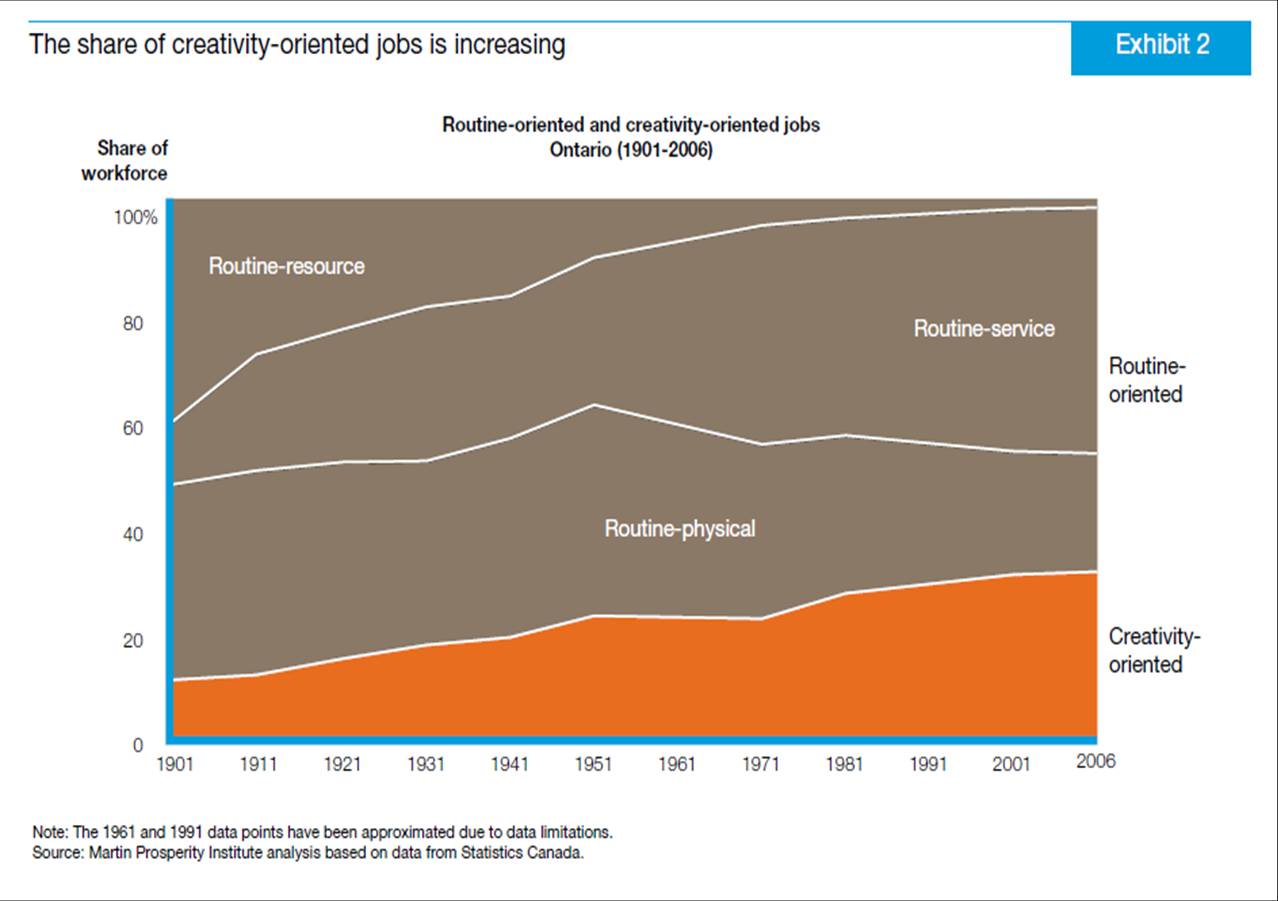
Still more interesting are the trends:
class conflict

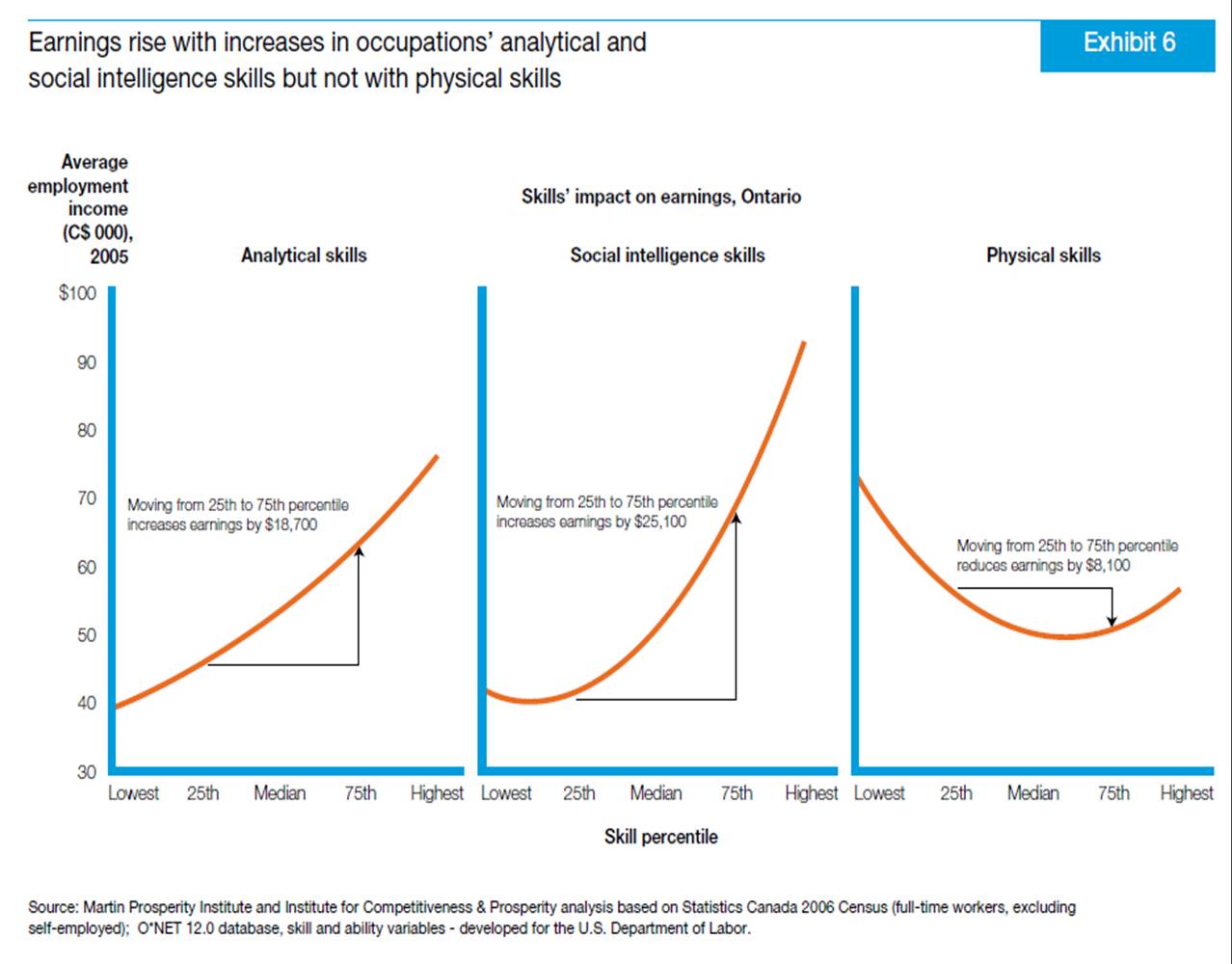
Combine this chart with there second chart that shows how wages grow depending on skill sets (no prizes for figuring out the Routine-physical-oriented jobs correlate with Physical Skills and that Social intelligence skills correlate with Creativity-Oriented jobs).

class wages

It is easy to see that the possibility of tension between routine-oriented and creativity-oriented workers could grow, especially as wage differences continue to increase.

Perhaps the most depressing conclusion to draw from this report is that the stimulus package will do little to address this inequity. A lot items that get funding in such packages (for example, some shovel ready projects) not only generate only temporary growth, but many of the jobs they foster are both becoming fewer – so we are encouraging job growth in shrinking job markets – and have a declining return on investment – so we are encouraging the development of skill-sets in workers that will not increase wages. Consequently, the very actions that traditionally might have helped stave of wage inequality (and in turn class conflict) may actually me exasperating the future likelihood of such inequality.

It’s hard to sell funding for R&D and research as these are often seen as “elite” activities, but interestingly they may offer us the greatest hope in reducing future tension and inequality. Sadly, research, science and education received little attention in the budget.

Creating a City of Vancouver that thinks like the web

Last November my friend Mark Surman – Executive Director of the Mozilla Foundation – gave this wonderful speech entitled “A City that Thinks Like the Web” as a lunchtime keynote for 300 councillors, tech staff and agency heads at the City of Toronto’s internal Web 2.0 Summit.

During the talk the Mayor of Toronto took notes and blackberried his staff to find out what had been done and what was still possible and committed the City of Toronto to follow Mark’s call to:

  1. Open our data. transit. library catalogs. community centre schedules. maps. 311. expose it all so the people of Toronto can use it to make a better city. do it now.
  2. Crowdsource info gathering that helps the city.  somebody would have FixMyStreet.to up and running in a week if the Mayor promised to listen. encourage it.
  3. Ask for help creating a city that thinks like the web. copy Washington, DC’s contest strategy. launch it at BarCamp.

The fact is every major city can and should think like the web. The first step is to get local governments to share (our) data. We, collectively as a community, own this data and could do amazing things with it, if we were allowed. Think of how Google Maps is now able to use Translink data to show us where bus stops are, what buses stop there and when the next two are coming!

Google Map Transit YVR

Imagine if anyone could create such a map, mashing up a myriad of data from local governments, provincial ministries, StatsCan? Imagine the services that could be created, the efficiencies gained, the research that would be possible. The long tail of public policy analysis could flourish with citizen coders, bloggers, non-profits and companies creating ideas, services, and solutions the government has neither the means nor the time to address.

If the data is the basic food source of such an online ecosystem then having it categorized, structured and known is essential. The second step is making it available as APIs. Interestingly the City of Vancouver appears to have taken that first step. VanMaps is a fascinating project undertaken by the City of Vancouver and I encourage people to check it out. It is VERY exciting that the city has done this work and more importantly, made it visible to the public. This is forward thinking stuff. The upside is that, in order to create VanMaps all the data has been organized. The downside is that – as far as I can tell – the public is restricted to looking at, but not accessing, the data. That means integrating these data sets with Google maps, or mashing it up with other data sets is not possible (please correct me if I’ve got it wrong).

Indeed, in VanMaps Terms of Use suggests that even if the data were accessible, you aren’t allowed to use it.

VanMaps EULA

Item 4 is worth noting. VanMap may only be used for internal business or personal purposes. My interpretation of this is that any Mashups using VanMap data is verboten.

But let’s not focus on that for the moment. The key point is that creating a Vancouver that thinks like the web is possible. Above all, it increasingly looks like the IT infrastructure to make it happen may already be in place.

Vision Fundraiser February 4th

There is a nice gala Vision Vancouver fundraiser coming up on February 4th for those who are interested. Here’s an opportunity to mix it up with the new Mayor and Vision Council members.

As the advertisement states:

Enjoy an evening of specialty tapas highlighting the multitude of Vancouver’s diverse neighborhoods, while mingling with Vancouver’s elected officials, business leaders, union brothers and sisters, social and environmental change agents, and others who are working to make a difference in their communities.

Tickets are $150.00 each with sponsorship opportunities available – for more information call Vision’s Fundraiser Kristi Rivait at 604-568-6913 or email her at kristi@votevision.ca

Why Smart Power matters

America cannot solve the most pressing problems on our own, and the world cannot solve them without America. The best way to advance America’s interest in reducing global threats and seizing global opportunities is to design and implement global solutions. This isn’t a philosophical point. This is our reality.

The president-elect and I believe that foreign policy must be based on a marriage of principles and pragmatism, not rigid ideology. On facts and evidence, not emotion or prejudice. Our security, our vitality, and our ability to lead in today’s world oblige us to recognize the overwhelming fact of our interdependence.

I believe that American leadership has been wanting, but is still wanted. We must use what has been called “smart power,” the full range of tools at our disposal — diplomatic, economic, military, political, legal, and cultural — picking the right tool, or combination of tools, for each situation. With smart power, diplomacy will be the vanguard of foreign policy. This is not a radical idea. The ancient Roman poet Terence, who was born a slave and rose to become one of the great voices of his time, declared that “in every endeavor, the seemly course for wise men is to try persuasion first.” The same truth binds wise women as well.

– Hillary Clinton, January 13th, 2009

During her confirmation hearing before the Senate Foreign Relations Committee Hillary Clinton used the term “Smart Power” no less than 12 times. It is a clever term, one that seeks to navigate between the Hard Power of military might and economic coercion, with the Soft Power of ideology, culture and agenda setting. Does the term signal something new in US foreign policy? Depends on your time frame. Without a doubt it marks the end of the George W. Bush foreign policy era. Clearly the blustery swagger of a shoot first, ask question later has ended. This is a United States that will be more cautious and more engaging. But rather than the start of something new, Smart Power likely signals a return to the Bill Clinton and Bush Sr. era of foreign policy. Indeed, as important as the term Smart Power was, the focus should lie not on the term, but on the revealing paragraph leading up to it:

“The president-elect and I believe that foreign policy must be based on a marriage of principles and pragmatism, not rigid ideology. On facts and evidence, not emotion or prejudice. Our security, our vitality, and our ability to lead in today’s world oblige us to recognize the overwhelming fact of our interdependence.”

Here the guiding principles behind the shift to Smart Power are revealed. Two strike me as paramount. The first reaffirms what I think will be the buzz word of the Obama administration: pragmatism. Despite his soaring speeches and inspiring words Obama is first and foremost interested in achieving the possible – stretch goals are fine – but ideological dreams are not for him. Second, in this speech, the United States’ next Secretary of State signalled to the world that it once again recognizes it cannot go it alone. The acknowledgement of interdependence is the antithesis of “you are with us or against us.” It is an recognition that allies – real allies, not the minnow states bullied into participation – are required to sustain and enhance the stability and prosperity of the international system. Bush Sr. understood this when creating his coalition for the first Gulf War, Clinton sought, insofar as possible, to build similar agreement when advancing his international agenda.

These have two dramatic impacts for Canada – and other countries. The first is that we should expect the Americans will ask us what we think – our advice or thoughts may not change their opinions, but we will likely be asked and when that happens, we’d better have something smart and meaningful to contribute. Second, the opportunity of being consulted comes with it the responsibility to contribute and support, even when the decision or strategy isn’t one that we completely agree with. When you’ve been part of the discussion you can walk away when the rubber hits the road. Third, those who have a well thought out plan for solving a problem will win out over those who have grievances to share. Demonstrate to this administration that you can solve a problem through realizable actions and I suspect they will listen and support you.

For Canadians nowhere is this change in attitude possible more important than on the management of the Canadian Border. I would have a new briefing plan of how we believe the border should be managed ready and waiting for when Clinton or Obama’s first arrives in Ottawa. If the Obama administration acts as it talks, I suspect it will reward and seek out, not those who do as it says, but those who solve the problems they care about. This is a welcome return to the diplomacy of the 1990’s which was also cautious and smart. It was also a good period for Canadian-American relations.

Canadians have spent years hoping the Americans will change. Now that they have, are we ready?