Tag Archives: vancouver

From here to open – How the City of Toronto began Opening up

Toronto the open

For myself, the biggest buzz at ChangeCamp Toronto was that the city showed up with lots of IT staff (much of it quite senior) who were trying to better understand how they could enable others to use their data and help citizens identify and solve problems. In fact the City of Toronto ran what I believe will be seen later as the most enduring sessions in which they asked what data should they start making available immediately (as APIs).

For those not in the know, think of an API as a plug that rather than delivering electricity instead delivers access to a database.

The exciting outcome is that web designers, coders and companies can then use this data to better deliver services, coordinate activities in neighborhoods, make government more transparent, or analyze problems. For example, imagine if all the information regarding restaurants health violations were not hidden deep within a government website (in a PDF format that is not easily searchable by google) but were available on every restaurant review website? Or if road closures were available in a data stream so a google maps application could show which road were closed on any given day – and email you if they were in your neighborhood.

This is the future that cities like Toronto are moving towards. But why Toronto? How did it arrive at this place? How is it that the City of Toronto sent staff to ChangeCamp Toronto?

The emergence of open in Toronto

I’ve tried to map this evolution. I may have missed steps and encourage people to email me or post comments if I have.
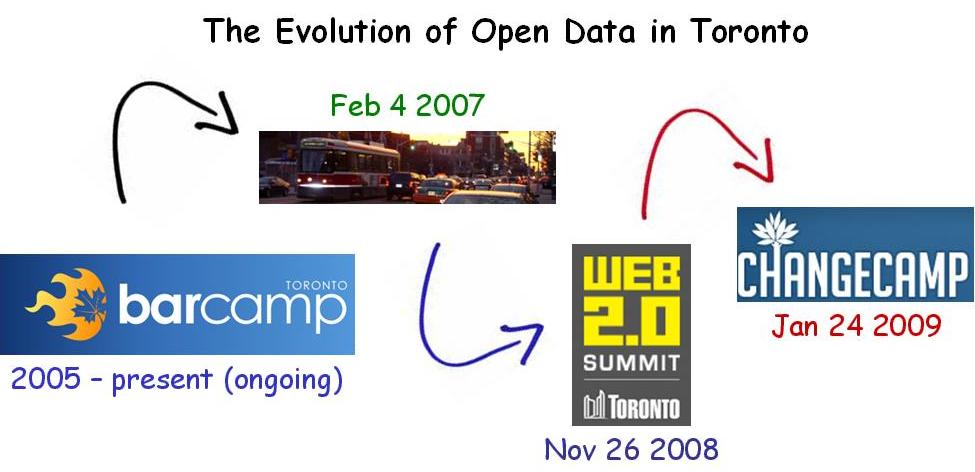
evolution of open data TO

The first step was taken when people like David Crow created a forum – Barcamp – around which some of Toronto’s vibrant tech and social tech community began to organize itself. This not only brought the community together but it also enabled unconferences to gain traction as a fun and effective approach to addressing an issue.

Then, in late 2006 the Toronto Transit Commission (TTC) issued an Request For Proposals (RFP) for a redesign of its website. Many in the tech community – who had no interest in doing the redesign – were horrified at the RFP. It was obvious that given the specifications the new website would not achieve its potential. A community self-organized around redesigning the RFP. Others took note and, because they cared about the TTC, wanted to also talk about simple non-website changes the TTC could make to improve services. TransitCamp was this born and – with enormous trepidation, some TTC officials showed up (all of whom should be loudly applauded). The result? The tech and social tech community in Toronto was engaged in civic matters and their activities were beginning to make it onto the city government’s radar.

Other Camps carried on through 2007 and 2008 (think OpenCities), building momentum in the city. Then, in November of 2008 – a breakthrough. The City of Toronto hosted an internal Web 2.0 conference and invited Mark Surman – executive director of the Mozilla Foundation and long time participant in the Toronto social tech space – to deliver the keynote entitled “A City that Thinks like the Web“. After the talk, the Mayor of Toronto stood up and said:

” … I’ve been emailing people about your challenges. Open data for Google Transit is coming by next June, and I don’t see what we shouldn’t open source the software Toronto creates.” He also said “I promise the City will listen” if Torontonians set up a site like FixMyStreet.com

You can hear the Mayor Miller’s full response here:

In short, the Mayor promised to begin talking about opening up (and open sourcing) the city. Freeing up Ryan Merkley and the City of Toronto IT team to attend ChangeCamp

Lessons for ChangeCamp Vancouver

It remains unclear to me whether ChangeCamp is the right venue for tackling this opportunity in Vancouver.

We in Vancouver are not as far along the arc as Toronto is. We do, however, have some advantages. The map is more obvious to us and some of us have good relationships with key staff in the city. However, this process takes time. To replicate the success in Toronto, governments here on the west coast need not only be at ChangeCamp, they need to be running sessions and deeply engaged. For this to occur cultures need to be shifted, new ideas need to percolate within government institutions and agencies and relationships need to be built. All this will take time.
The creative age, the budget and the future of class conflict

Yesterday the Martin Prosperity Institute released its report Ontario in the Creative Age. I’ve been reading through it with great, great interest. The influence of Rise of the Creative Class and Who’s Your City is obvious (and expected) and the report is an important and fantastic read. Regardless of whether or not you live in the GTA/Ontario, I highly recommend it. Indeed, I would love to see the Province of British Columbia and the Metro Vancouver commission a similar report. I can imagine the methodology is now in place to do one relatively quickly, and it is urgently needed on the west coast. (Can anyone point to an economic development plan for the Greater Vancouver Area? For the City of Vancouver?)

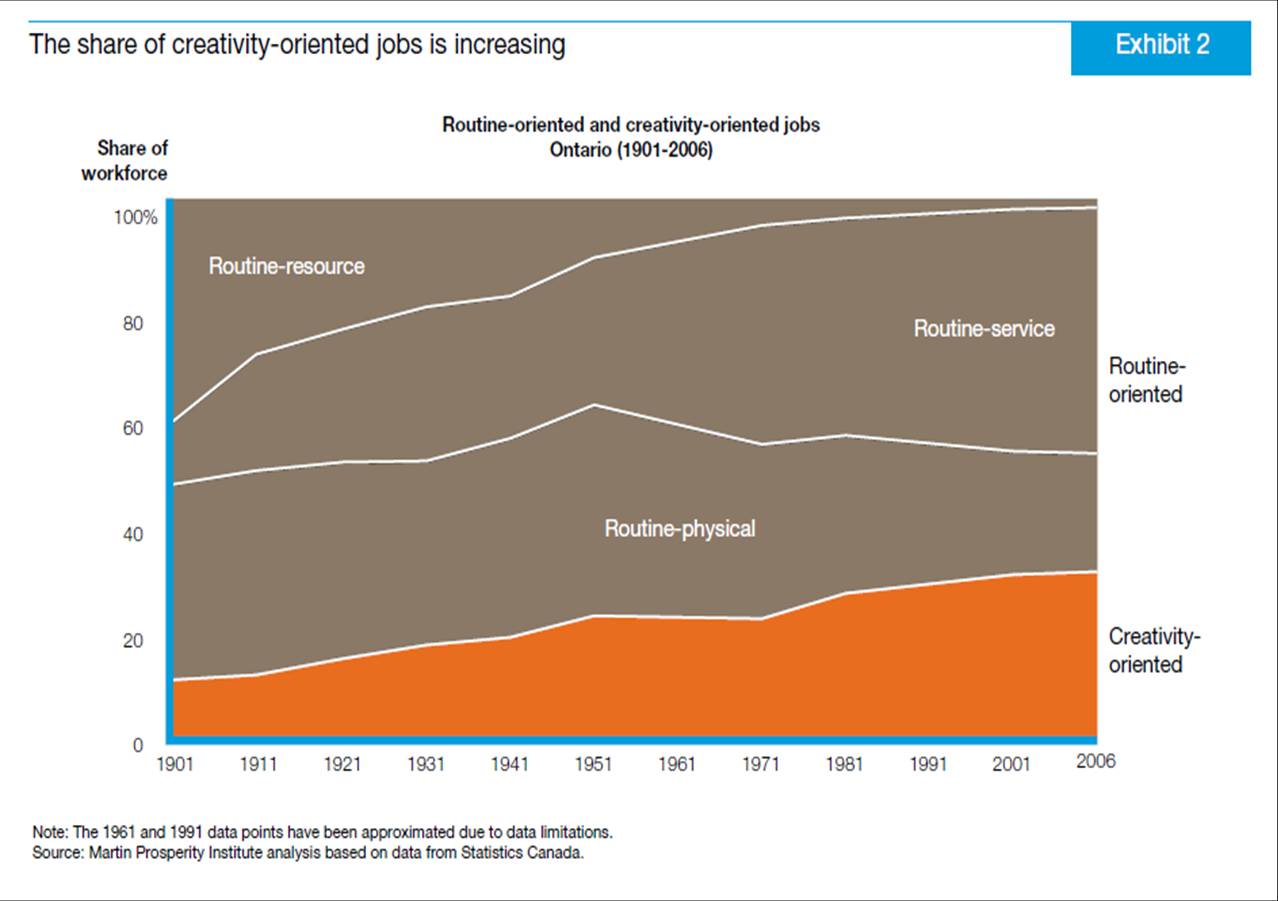
The report also plays on a theme that has interested me for a while now. The nature of class conflict in networked and creative economy. The report tackles the issue more directly than anything else I’ve seen by Florida to date. This line from the report is illustrative:

The rise of creativity is a double-edged sword. It creates tremendous wealth creation opportunities for some. Yet it can leave many behind – particularly those in jobs built on routine, and those who do not have the opportunity to gain the skills to participate advantageously in the economic transformation we are going through.

Still more interesting are the trends:
class conflict

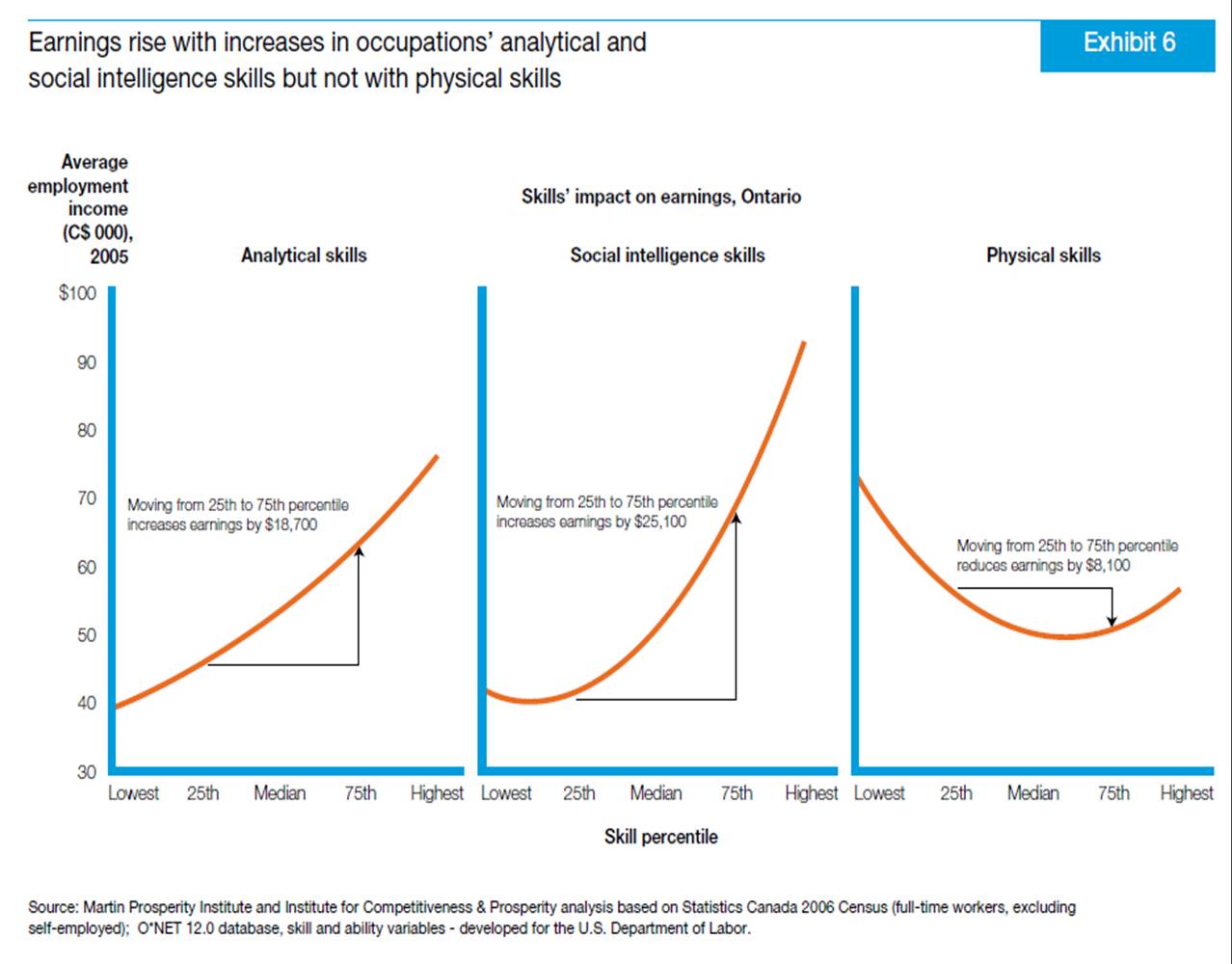
Combine this chart with there second chart that shows how wages grow depending on skill sets (no prizes for figuring out the Routine-physical-oriented jobs correlate with Physical Skills and that Social intelligence skills correlate with Creativity-Oriented jobs).

class wages

It is easy to see that the possibility of tension between routine-oriented and creativity-oriented workers could grow, especially as wage differences continue to increase.

Perhaps the most depressing conclusion to draw from this report is that the stimulus package will do little to address this inequity. A lot items that get funding in such packages (for example, some shovel ready projects) not only generate only temporary growth, but many of the jobs they foster are both becoming fewer – so we are encouraging job growth in shrinking job markets – and have a declining return on investment – so we are encouraging the development of skill-sets in workers that will not increase wages. Consequently, the very actions that traditionally might have helped stave of wage inequality (and in turn class conflict) may actually me exasperating the future likelihood of such inequality.

It’s hard to sell funding for R&D and research as these are often seen as “elite” activities, but interestingly they may offer us the greatest hope in reducing future tension and inequality. Sadly, research, science and education received little attention in the budget.

Creating a City of Vancouver that thinks like the web

Last November my friend Mark Surman – Executive Director of the Mozilla Foundation – gave this wonderful speech entitled “A City that Thinks Like the Web” as a lunchtime keynote for 300 councillors, tech staff and agency heads at the City of Toronto’s internal Web 2.0 Summit.

During the talk the Mayor of Toronto took notes and blackberried his staff to find out what had been done and what was still possible and committed the City of Toronto to follow Mark’s call to:

  1. Open our data. transit. library catalogs. community centre schedules. maps. 311. expose it all so the people of Toronto can use it to make a better city. do it now.
  2. Crowdsource info gathering that helps the city.  somebody would have FixMyStreet.to up and running in a week if the Mayor promised to listen. encourage it.
  3. Ask for help creating a city that thinks like the web. copy Washington, DC’s contest strategy. launch it at BarCamp.

The fact is every major city can and should think like the web. The first step is to get local governments to share (our) data. We, collectively as a community, own this data and could do amazing things with it, if we were allowed. Think of how Google Maps is now able to use Translink data to show us where bus stops are, what buses stop there and when the next two are coming!

Google Map Transit YVR

Imagine if anyone could create such a map, mashing up a myriad of data from local governments, provincial ministries, StatsCan? Imagine the services that could be created, the efficiencies gained, the research that would be possible. The long tail of public policy analysis could flourish with citizen coders, bloggers, non-profits and companies creating ideas, services, and solutions the government has neither the means nor the time to address.

If the data is the basic food source of such an online ecosystem then having it categorized, structured and known is essential. The second step is making it available as APIs. Interestingly the City of Vancouver appears to have taken that first step. VanMaps is a fascinating project undertaken by the City of Vancouver and I encourage people to check it out. It is VERY exciting that the city has done this work and more importantly, made it visible to the public. This is forward thinking stuff. The upside is that, in order to create VanMaps all the data has been organized. The downside is that – as far as I can tell – the public is restricted to looking at, but not accessing, the data. That means integrating these data sets with Google maps, or mashing it up with other data sets is not possible (please correct me if I’ve got it wrong).

Indeed, in VanMaps Terms of Use suggests that even if the data were accessible, you aren’t allowed to use it.

VanMaps EULA

Item 4 is worth noting. VanMap may only be used for internal business or personal purposes. My interpretation of this is that any Mashups using VanMap data is verboten.

But let’s not focus on that for the moment. The key point is that creating a Vancouver that thinks like the web is possible. Above all, it increasingly looks like the IT infrastructure to make it happen may already be in place.

Must see show this Sunday in Vancouver

It’s Friday and time to prepare for the weekend. In that spirit the perfect opportunity has arisen to both notify Vancouverites of a great cultural opportunity and give a shout out to my friend Misha Glouberman who is bringing his famous Trampoline Hall event to Vancouver! What is Trampoline Hall you ask? Look no further then the links above, the text below or the event’s facebook page:

Trampoline Hall is a barroom lecture series usually based in Toronto, but sometimes in other places. On Feb 1, it will be in Vancouver for the first time, as part of the Push Festival.

Trampoline Hall is this: Three people talk, on subjects outside their professional field of expertise. The lectures are sometimes ridiculous, sometimes moving, and always wildly unpredictable. Each talk is followed by a Q&A with the audience which is usually also a lot of fun.

Trampoline Hall was invented by the writer Sheila Heti, and is hosted by Misha Glouberman. In Toronto, it is something of an institution, playing every month for the past seven years or so. It’s also played to great crowds in around a dozen US cities, including Atlanta, Boston, New York, Louisville, Chicago, and San Francisco. Feb 1 will be Trampoline Hall’s first time in Vancouver.

All lecturers for the Vancouver show selected are selected by Veda Hille. Here is the lineup she has chosen:

1) Andrew Feldmar will talk about Cooking from Memory.
2) Kevin Chong will discuss Fraternal Polyandry
3) Faith Moosang will assert “There are Clues Everywhere!!” in a talk about Nancy Drew.

~~~~

“”Unruly… Caustically Funny” – Durham Independent

“They’ve been doing this for several years up in Toronto… now New Yorkers are in its thrall. Clearly, we love it.” – The Village Voice

“Cloud-splitting Genius” – Lola Magazine

“Eccentricity and do-it-yourself inventiveness” – The New Yorker

I’m hoping my plane lands in time so that I can make it!

Vision Fundraiser February 4th

There is a nice gala Vision Vancouver fundraiser coming up on February 4th for those who are interested. Here’s an opportunity to mix it up with the new Mayor and Vision Council members.

As the advertisement states:

Enjoy an evening of specialty tapas highlighting the multitude of Vancouver’s diverse neighborhoods, while mingling with Vancouver’s elected officials, business leaders, union brothers and sisters, social and environmental change agents, and others who are working to make a difference in their communities.

Tickets are $150.00 each with sponsorship opportunities available – for more information call Vision’s Fundraiser Kristi Rivait at 604-568-6913 or email her at kristi@votevision.ca

on snow

From an im message I sent this morning:  my views on snow. I think it encapsulates Vancouverites position on the issue:

Snow should be like grandchildren. Fun, playful and always a car ride away.

I supposed given my age, I should say snow should be like nieces and nephews…

You can ignore eaves.ca today. It is going to be nothing my mindless fun. Not that it matters much, the hit counter is way down, which is as it should be on Christmas Eve.

Sean Yo just sent me a link of Merb and ruby merging. Hoping to blog about it shortly.

Twittering to help the homeless – and why it is bad!

Here is a great story out of Vancouver of a group of strangers using twitter to come together and help the homeless.

Another example of how social media can build new friends and community and help make the world a better place – sadly we all know it won’t have any impact of the powerful narrative of youth as uncaring, self-centred narcsistic and apathetic.

And then there are those who think these tools are really just the hands of the devil. I didn’t know anyone still read Andrew Keen but the other day a reader pointed to his (1000th) column on how the internet will end society as we know it. Check out this excerpt:

The 1930s fascists were expert at using all the most technologically sophisticated communications technologies—the cinema, radio, newspapers, advertising—to spew their destructive, hate-filled message. What they excelled at was removing the the traditional middlemen like religion, media, and politics, and using these modern technologies of mass communications to speak with reassuring familiarity to the disorientated masses.

Imagine if today’s radically unregulated Internet, with its absence of fact checkers and editorial gatekeepers, had existed back then. Imagine that universal broadband had been available to enable the unemployed to read the latest conspiracy theories about the Great Crash on the blogosphere. Imagine the FDR-baiting, Hitler-loving Father Charles Coughlin, equipped with his “personalized” YouTube channel, able, at a click of a button, to distribute his racist message to the suffering masses. Or imagine a marketing genius like the Nazi chief propagandist Josef Goebbels managing a viral social network of anti-Semites which could coordinate local meet-ups to assault Jews and Communists.

You can almost feel the anger and rage ooze off the screen – try reading the whole thing. I can see why Keen is scared – he probably has visions of people like him running around the internet. That said, he’s ultimately right on one level, anyone can use these tools. But the solution is what? To ban them all? Regulate them into ineffectiveness? Ultimately you can’t have the opportunity of self-organizing enlightenment without the possibility of self-organizing hatred. But maybe then, we don’t want kids wandering making friends and helping homeless people. Yes, now that I reflect on it, being a passive hollywood and park avenue fed consumer was always so much better for society, democracy and freedom. Thank you for saving me from myself Andrew Keen!

Quote of the day

“I think nobody really loves America more than black Americans, because black Americans loved America even when America didn’t love us back”

– Jamal Simmons

I was fortunate enough to see Jamal Simmons give the keynote at yesterday’s Canadian-American Business Council luncheon and this line really just floored me. In fact, I think I and a few others in the room almost got emotional when he said it. It’s difficult to imagine the pain induced by that kind of rejection from a community you care so much about.

Twittering the Vancouver Election

For those living in Vancouver, or interested in Vancouver politics, the CBC will be hosting a debate tomorrow between Vision Vancouver Mayoralty candidate Gregor Robertson and his NPA counterpart.

For those listening in on or attending the debate, the CBC is interested in hearing your immediate thoughts and feedback via twitter – simply tag your tweet: #cbcmayorsdebate and the CBC may pick it up. Thoughtful comments about Gregor, concerns about the city, or respectfully expressed concerns about NPA spin are particularly appreciated.

For those interested in the debate it is taking place tomorrow, Wednesday, November 12, from 7:30 – 9:00 p.m. at the SFU’s Segal Graduate School of Business, 500 Granville St.. It will also be broadcast live on CBC Radio One (690AM) in Vancouver and streamed live over “the interweb” at cbc.ca/bc.

If you are a vision supporter – we are in crunch time. Please do vote!  Also consider donating some money or volunteering for our e-day get out the vote initiative and, to have fun, get yourself on “the map!”

dinner with winners

Friends in Vancouver – if you have any interest in attending the Vision Vancouver Fall Fundraiser please don’t be shy in dropping me a line.

I’m pretty excited about Vision’s new slate – which you can read about here – and our prospects in the upcoming election. These are exciting times for Vancouver – I get the sense that people want to see the city grow and mature in a way they haven’t before. That is certainly one of the reasons I moved back here and got involved in Vision.

If you want to start to see what it’s all about, come on out for the dinner…